9.1 Definition Orbit
[[Math/ Books/A First Course in Abstract Algebra.pdf#page=92&selection=504,0,522,1&color=note|p.87]]
Let σ be a permutation of a set A. The equivalence classes in A determined by the equivalence relation (1) are the orbits of σ .
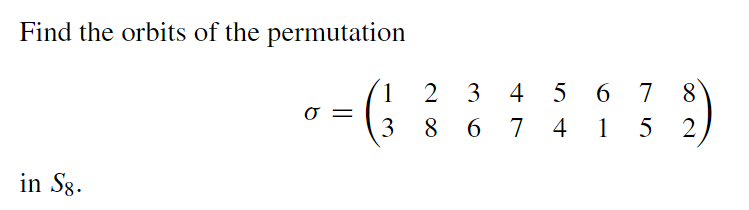 1→3→6→1→…
- Depends on a whole group G: OrbG(x) collects every image of x under every element of the group.
- It is a subset of the underlying set X on which G acts.
9.6 Definition Cycle
[[Math/ Books/A First Course in Abstract Algebra.pdf#page=94&selection=7,0,26,0&color=note|p.89]]
A permutation is a cycle if it has at most one orbit containing more than one element. The length of a cycle is the number of elements in its largest orbit.
- Describes a single permutation : it shows how sends each element “in a loop” among a small subset of .
- It is part of the notation or decomposition of inside .
9.8 Theorem
[[Math/ Books/A First Course in Abstract Algebra.pdf#page=94&selection=261,0,265,47&color=note|p.89]]
Every permutation σ of a finite set is a product of disjoint cycles.
9.11 Definition
[[Math/ Books/A First Course in Abstract Algebra.pdf#page=95&selection=214,0,218,1&color=note|p.90]]
A cycle of length 2 is a transposition.
9.15 Theorem
[[Math/ Books/A First Course in Abstract Algebra.pdf#page=96&selection=40,0,46,60&color=note|p.91]]
No permutation in Sn can be expressed both as a product of an even number of transpositions and as a product of an odd number of transpositions.
Think about a determinant. Exchange any two rows of a square matrix changes the sign of the determinant.
A Permutation that can be expressed as a product of an even number of transpositions is called a even permutation. Similar to a odd permutation.
9.21 Definition Alternating Group
[[Math/ Books/A First Course in Abstract Algebra.pdf#page=98&selection=355,0,378,1&color=note|p.93]]
The subgroup of consisting of the even permutations of n letters is the alternating group on n letters.