Definition
If the starting and ending point of a path are the same, then this path is called a loop The common starting and ending point is referred to as the basepoint
The set of all homotopy classes of loops at the basepoint is denoted
Proposition 1.3 ( Algebraic Topology, p.35)
is a group with respect to the product
This group is called the fundamental group of at the basepoint
Further we can show that the map is an isomorphism
Thus if is path-connected, the group is, up to isomorphism, independent of the choice of basepoint . In this case the notation is often abbreviated to or .
Functoriality
We can view as a covariant functor (a covariant functor preserves the direction of morphisms)
notation
We use to denote the translated after applying the functor
- For objects:
- For morphisms: where
- is a continuous map
- is a group homomorphism with
- identity preservation: The continuous map induces the identity homomorphism
- composition map: for composition
- proof: For any we have
Note that any continuous map induces a group homomorphism given by ( is a loop here)
We can check is indeed a homomorphism: Since if and are loops at , then as loops at (see 13.1 Definition)
Theorem 1.18/2.26
If is a homotopy equivalence, then is an isomorphism.
geometric examples
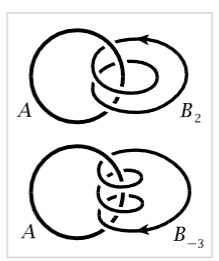 an infinite cyclic group (free group on one generator)
AB are not linked
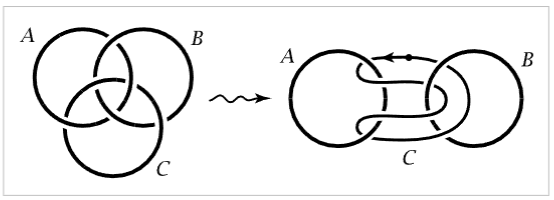 nonabelian free group on two generators
AB are linked
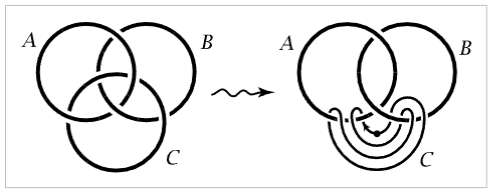 free abelian group on two generators
Important
One can often show that two spaces are not homeomorphic by showing that their fundamental groups are not isomorphic,
Check this nice visualization video on YouTube
Example: Circle
We show that ( meaning isomorphism here) Claim
Theorem 1.7 Algebraic Topology, p.38
is an infinite cyclic group generated by the homotopy class of the loop based at
Using the definition of Covering Space: …
- Proof
Proposition 1.12
is isomorphic to if and are path-connected
Proposition 1.14
if
Corollary 1.16
is not homeomorphic to for
For Suppose there is a homeomorphism between and However, we can see that is path-connected while is not. This implies that they cannot be homeomorphic.
For Suppose there is a homeomorphism between and , then must still have a homeomorphism to (since is bijective) We know is homeomorphic to is isomorphic to (by Proposition 1.14) So for and otherwise. Therefore, such a homeomorphism cannot exist. (by Theorem 1.18/2.26, note that homeomorphism implies homotopy equivalence)
Fundamental Theorem of Algebra
Every nonconstant polynomial with coefficients in has a root in
Assume has no roots in . For each radius , consider the loop obtained by mapping the circle through and then normalizing to the unit circle:
Because has no zeros, this is well-defined. As varies, the loops form a based homotopy. At , the loop is constant, so
for every .
Now choose sufficiently large. On , the leading term dominates all lower-order terms Therefore the family
has no zeros on . This gives a homotopy between the loop induced by and the loop induced by .
But the loop induced by is
which winds around exactly times. Hence it represents
Thus So , meaning is constant. Therefore every nonconstant complex polynomial must have a root in .
See the proof of this theorem using analysis: Fundamental Theorem of Algebra