What is a Category
A category consists of four things:
- Objects: a class called the class of objects of
- Morphisms: For all , a set of morphisms (called the homset of morphisms from A to B)
- Composition: The morphisms composition function
- Identity: For all , a morphism called the identity on A.
They follow the following properties:
- This composition is associative: if , ,
- for all we have .
What is a class
A class is a collection of objects. One can think it as a fancy way of calling a collection.
Tip
Every set can be considered as a class
We cannot have a set of all sets (because of Russell paradox) However, we can have a class of all sets, which is called a proper class (a class that is not a set) A proper class cannot be a member of any other set of class.
Difference between Morphism and Function
| Aspect | Function | Morphism |
|---|---|---|
| Definition | A mapping between two sets | An arrow in an arbitrary category |
| Domain & Codomain | Both must be sets | Can be any objects (sets, groups, spaces, etc.) |
| Structure Requirement | No extra requirements beyond “each input has a unique output” | Must preserve the structure of its category (e.g. group law, topology) |
| Identity | Identity function on set A | Identity morphism on object AA |
| Examples | Any rule mapping elements of one set to another (e.g. ) | In Set: functions; in Grp: group homomorphisms; in Top: continuous maps |
| See Morphisms |
Examples 1
| Category | Objects | Morphisms | Composition | Identity on A |
|---|---|---|---|---|
| all sets | all functions | usual composition of functions | identity function | |
| all sets | all binary relations | relational composition: two Relations : so that | the equality relation | |
| Similar Morphisms can also be multivalued map or partial functions… |
Examples 2
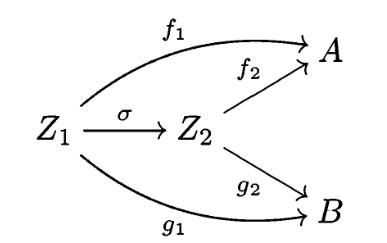
Consider an abstract Example Let C be a category, and let A be an object of C We define a category with:
- = all morphisms from any objects of C to A (e.g. )
- Morphisms:
- Composition:
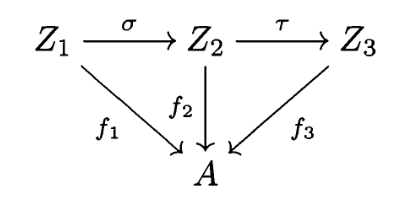
- Because C is a category, we can remove the central arrow according to the composition law,
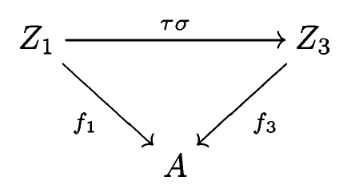
- which gives us the composition in (it commutes)
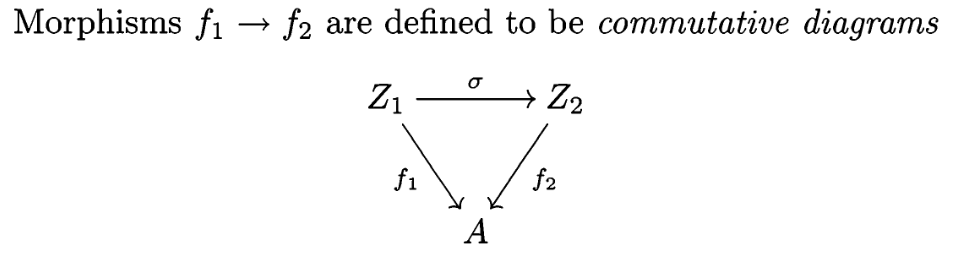
Examples 3
Consider another coslice category
Let category C=Set and A = a fixed singleton (any set that contains only one single element)
Define category Set* as the category obtained by considering morphisms in C from the fixed object A to all objects in C.
- An object in Set* is a morphism
- This object should can be described by where is any element of . (a pointed set)
- A function from the singleton set to any set is uniquely determined by the image of that single point—namely, once the element is specified, the entire function is completely characterized. Thus we don’t need to write out how looks like.
- A morphism between two such objects is with set function
- s and t are here basepoints.
Object of Set* are called pointed setsCategory Example.excalidraw
⚠ Switch to EXCALIDRAW VIEW in the MORE OPTIONS menu of this document. ⚠ You can decompress Drawing data with the command palette: ‘Decompress current Excalidraw file’. For more info check in plugin settings under ‘Saving’
Excalidraw Data
Text Elements
S
T
{*}
f(*)=s
f(*)=t
σ(s)=t
Link to original
Example 4
Consider
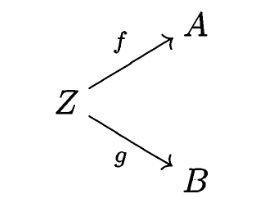 Morphisms: