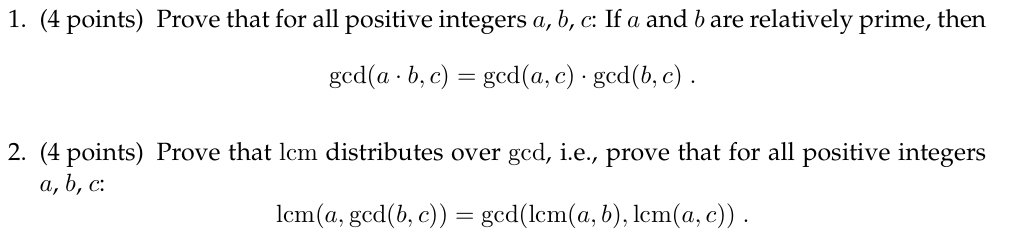
Let d1=gcd(a,c) and d2=gcd(b,c).
We first show that gcd(d1,d2)=1
Assume there is a common divisor x of d1 and d2 with x>1 , then x∣gcd(a,c) and x∣gcd(b,c)
By definition of gcd, we get x∣a and x∣c and x∣b
This contradicts to the statement that gcd(a,b)=1, so gcd(d1,d2)=1 must hold.
We then show that d1d2∣gcd(ab,c)
Since d1∣a and d2∣b, we can conclude that d1d2∣ab
We also know that d1∣c and d2∣c, and gcd(d1,d2)=1
set c=kd1 where k a positive integer (since d1∣c)
so d2∣c gives d2∣kd1
Because gcd(d1,d2)=1, Euclid’s lemma implies d2∣k. Let’s then write k=d2t where k is also a positive integer
Therefore c=d1k=d1d2t
Hence, d1d2∣c
According to the definition of gcd(ab,c), we have ∀x((x∣ab∧x∣c)→x∣gcd(ab,c))
Let x=d1d2 (since d1d2 satisfies d1d2∣ab and d1d2∣c). Then we must have d1d2∣gcd(ab,c)
We then show that gcd(ab,c)∣d1d2
Let d=gcd(ab,c) with d∣ab and d∣c
we write d as d=∏ipiei. Because gcd(a,b)=1, each prime of d divides exactly a or b. we then split d into d=dadb with da∣a (containing primes that divides a) and db∣b (containing primes that divides b)
Since d∣c, we get da∣c and db∣c. Thus da∣d1 and db∣d2
Therefore, we get d=dadb∣d1d2, meaning gcd(ab,c)∣d1d2Conclusion
By showing d1d2∣gcd(ab,c) and gcd(ab,c)∣d1d2, we proved that d1d2=gcd(ab,c), which means gcd(ab,c)=gcd(a,c)⋅gcd(b,c)
The claim is proved.
We now only need to prove that max(ei,min(fi,gi))=min(max(ei,fi),max(ei,gi))
We show that max(x,min(y,z))=min(max(x,y),max(x,z))
case 1: x≥min(y,z)
max(x,min(y,z))=x
At least one of y and z is smaller or equal to z. Therefore one of max(x,y) and max(x,z) must be x and the other one must be greater or equal to x. Hence, min(max(x,y),max(x,z)) must be x. Thus, max(x,min(y,z))=min(max(x,y),max(x,z))=x
case 2: x<min(y,z)
max(x,min(y,z))=min(y,z)
max(x,y)=y and max(x,z)=z, so we have min(max(x,y),max(x,z))=min(y,z)
max(x,min(y,z))=min(max(x,y),max(x,z))=min(y,z)
Hence, the statement max(x,min(y,z))=min(max(x,y),max(x,z)) always holds
Therefore,