For n=3det100001010=−det100010001=−1
the matrix [a22a32a23a33] is flipped and thus must multiply −1, same principle to example
We can see that if we exchange two rows, the determinant must multiply −1
Another Perspective
computing the determinant of a 2×2 matrix as the area of the image of the unit square after a linear transformation
General case
Definition 7.2.1
Given a permutation π:{1…n}→{1…n} of n elements
sgn(π)={1 if ∣{(i,j)∣i<j and π(i)>π(j)}∣ is even−1 if ∣{(i,j)∣i<j and π(i)>π(j)}∣ is odd
Example
det010001100π(1)=3>π(2)=1π(1)=3>π(3)=2π(2)=1<π(3)=2sgn(π)=1det010001100 is positive (actually det010001100=1)
Definition: determinant
det(A)=σ∈∏n∑sgn(σ)i=1∏nAi,σ(i)
Properties
det(A⊤)=det(A)
det(I)=1
The columns are linear dependent ⟹det(A)=0
linear
Let π be a permutation, and P(π) is the permutation matrix
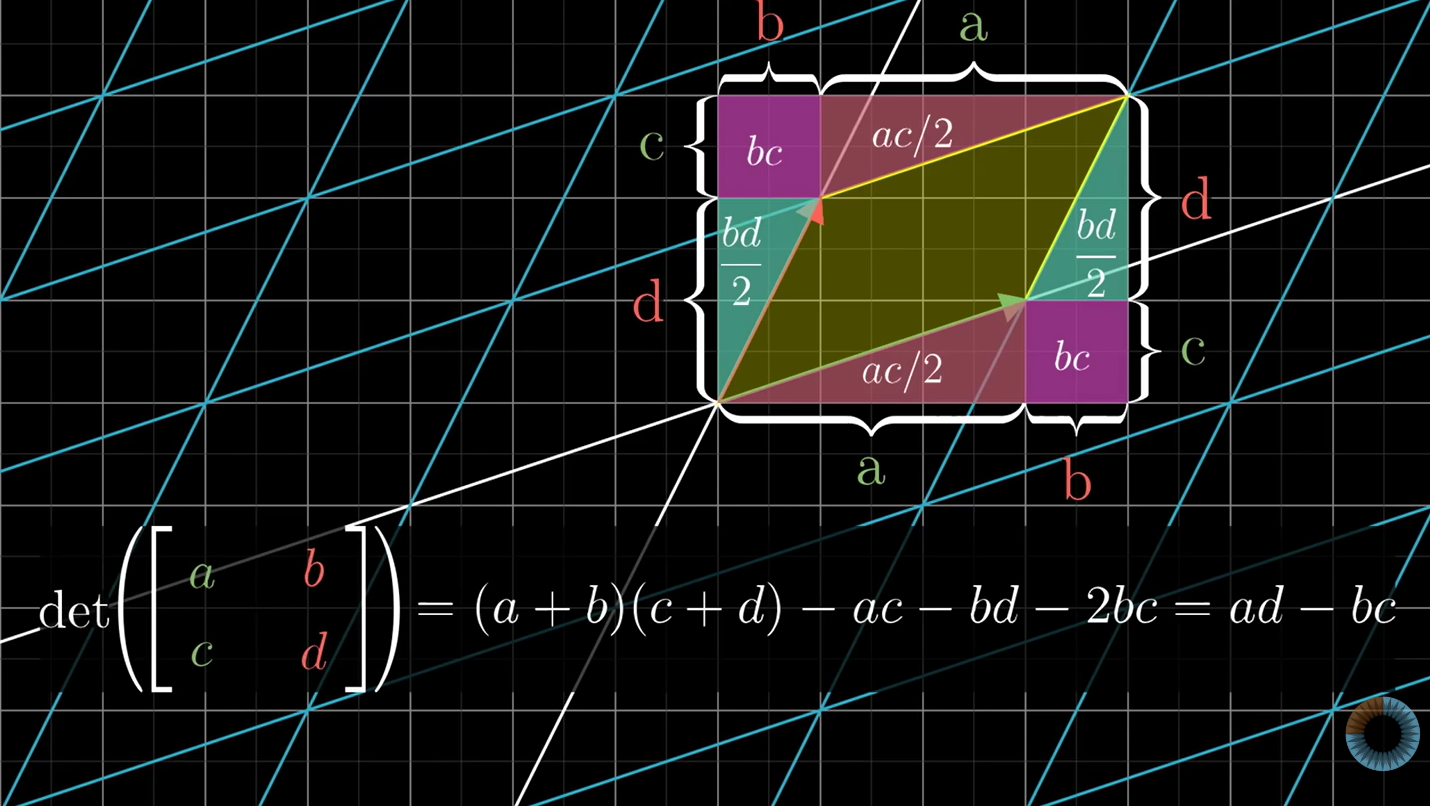 computing the determinant of a matrix as the area of the image of the unit square after a linear transformation