a)
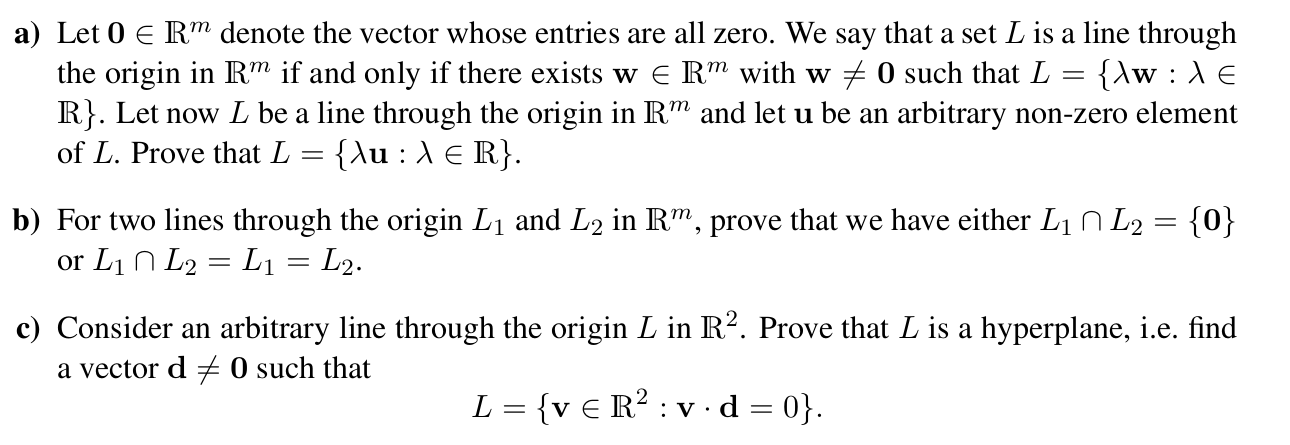
Since u∈L, u=λ2w for some λ2∈Rw=λ2uL={λ1w:λ1∈R}={λ2λ1u:λ1∈R,λ2∈R}={λu:λ∈R}
b)
L1={λ1v:λ1∈R}L2={λ2w:λ2∈R}
L1=L2λ1v=λ2w
either λ1=0,λ2=0 meaning that L1∩L2={0}
or
v=λw,λ∈R meaning that w is a element of L1, and according to question a, they must be the same line.
c)
v⋅w=0(v1v2)(d1d2)=0v1d1+v2d2=0v1=−d1d2v2v1=−d1d2λ,v2=λ,λ∈Rv=(v1v2)=λ(−d1d21),λ∈RL={λ(−d1d21):λ∈R}
and this is a line
2. Orthogonality and Linear independence
a)
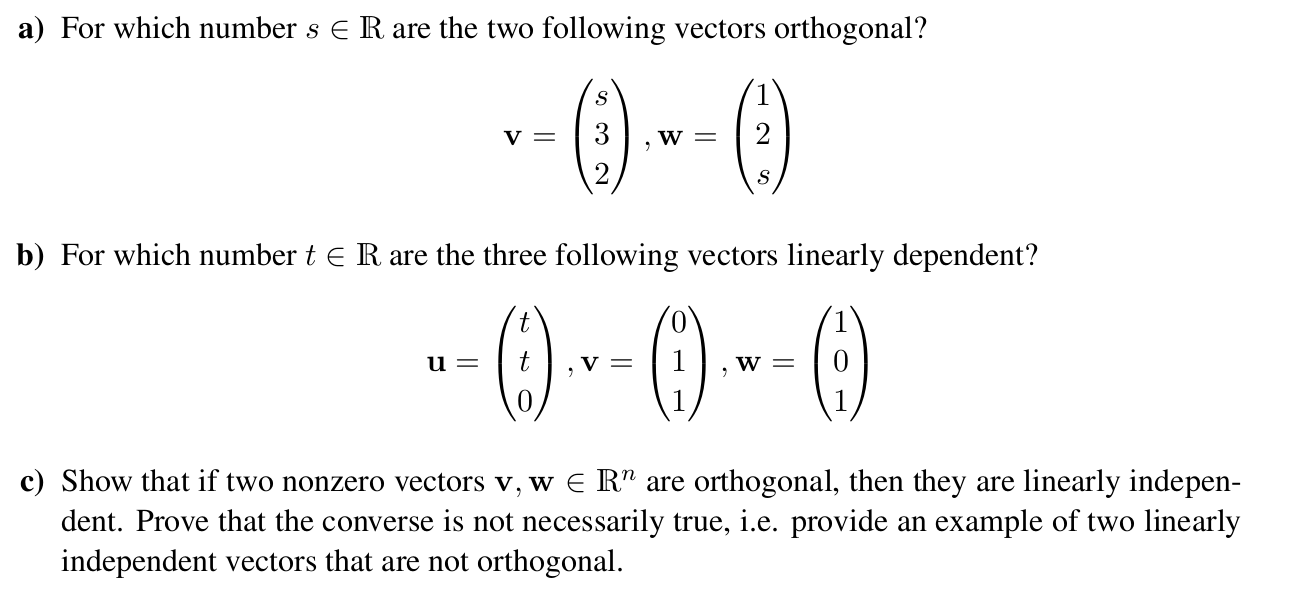
v⋅w=0s+6+2s=0s=−2
b)
t=0
c)
v⋅w=0
suppose v,w are linearly dependent: w=λvv⋅λv=0λ(v⋅v)=0v⋅v=0∑i=1nvi2=0
There is no nonzero solution to this equation, so v and w must be linearly independent
b)
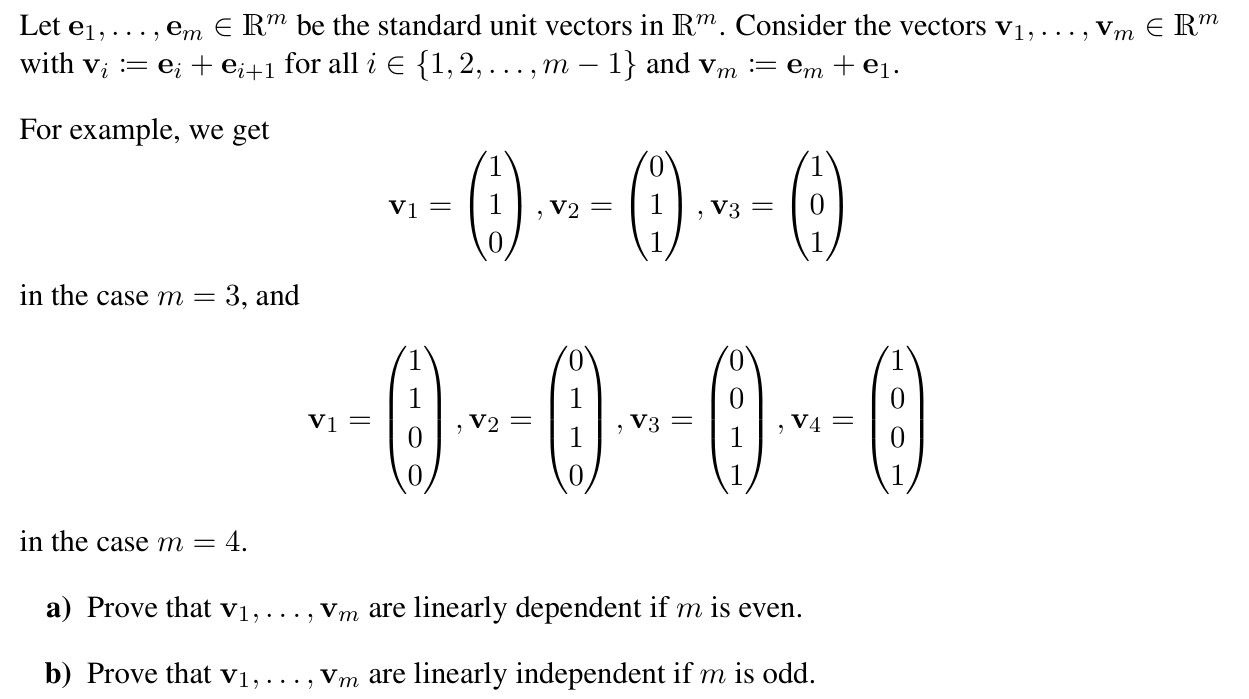
∑i=1nλivi=0
Looking at the i-th coordinate gives λi+λi−1=0 (indices mod m)
Hence λi=(−1)i−1λ1λ1+λm=0⟹λ1+(−1)m−1λ1=0
Since m is odd then (−1)m−1=1, so 2λ1=0⟹λ1=0 and thus all λi=0, which is a trivial linear combination.
Therefore v1,…,vm are linearly independent
 a)
Since , for some
a)
Since , for some
 a)
a)
 a)
a)
