1. Subspaces of function spaces and
a)
- Non-empty: all constant function
- closed under addition: , arbitrary
- closed under scalar multiplication: , , arbitrary
- is a subspace
b)
Proof: For let be the matrix with 1 at and 0 elsewhere We try to prove that is the basis of
- Spanning: Any diagonal matrix can be expressed as for
- Linear independence: Consider the equation .
- must be zero, which shows the linear independence of is the basis of Since the dimension is the cardinality of a basis.
2. Skew-symmetric matrices as a subspace
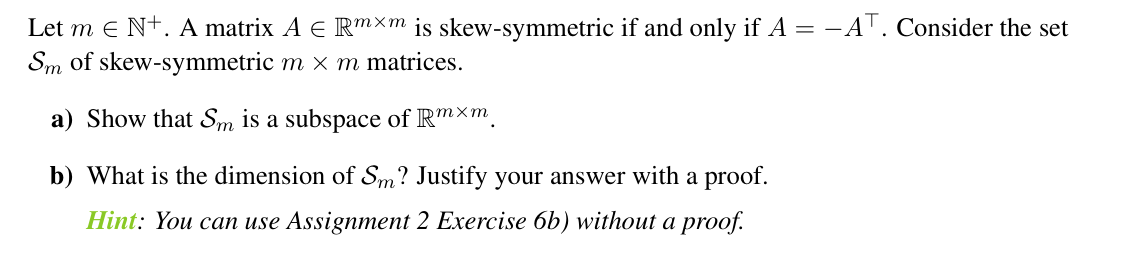
a)
we prove the claim by showing the following statements (using the definition of Subspaces)
- for all we have
- is a skew-symmetric matrix and thus
- for all and we have
- is a skew-symmetric matrix and thus Hence, is a subspace of
b)
The dimension of is
We define:
We prove the set is a basis of
- This set spans
- For any matrix in we can write as a linear combination of the matrices
- so the -th entry is (), and the -th entry is , matching the structure of
- Therefore spans
- This set is linear independent Assume
Consider the -entry with . Since only has a nonzero element in that position, we obtain This holds for all Hence all coefficient are zero, and the set is linear independent. Conclusion Now we have a basis of The size of this basis is the number of elements on top of the diagonal of a matrix in , which can be calculated by