What is this about?
Determining if a graph is connected (i.e., there is a path between any two vertices).
u-v-Separator
Let be a graph. and is u-v-Separator if are in different connected components of
is a set of vertices that separate , into different connected components.
k-vertex-connected
is k-vertex-connected:
- Every u-v-Separator has size
Simpler Definition
The minimum number of vertex whose removal disconnects the graph is at least k.
If a graph is -vertex-connected then it is automatically -vertex-connected (same for edge-connected)
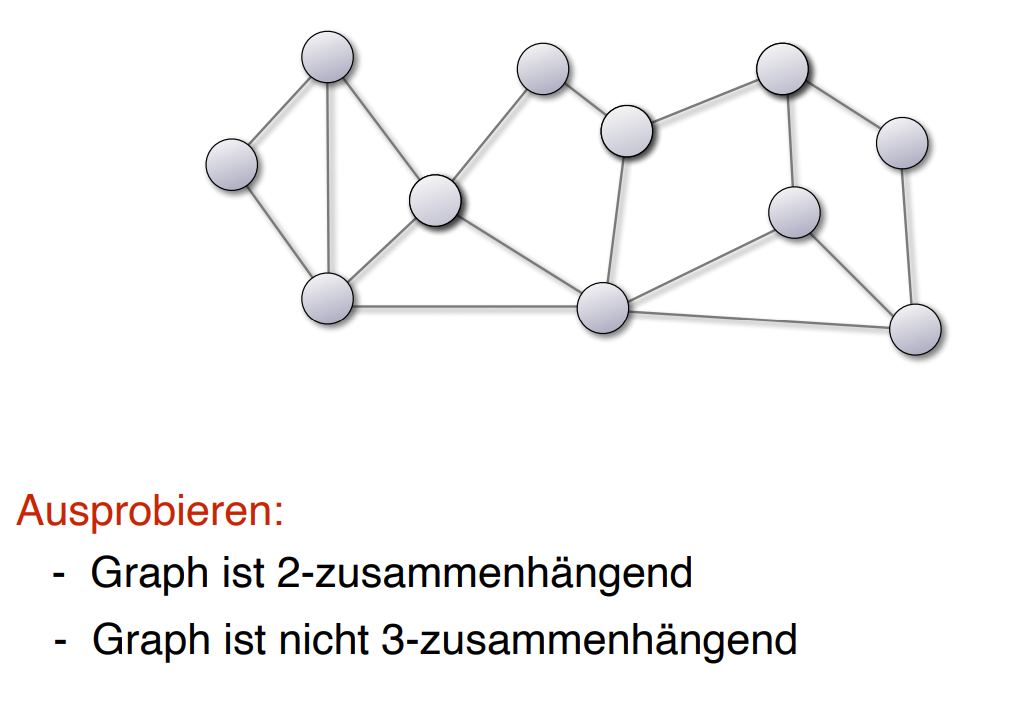
Menger’s Theorem (vertex)
NOTE
is k-vertex-connected:
- (distinct) there exist at least internally vertex-disjoint paths between and v.
- Every u-v-Separator has
It’s pretty hard to prove “If every u-v-separator has size at least , then there exist pairwise internally disjoint s- paths”
- Proof
Menger’s Theorem (edge)
NOTE
A graph is k-edge-connected if and only if for every pair of distinct vertices, there exist at least k-edge-disjoint paths between them.
Under this definition u-v-separators are now u-v-edge-separators where
Relationship between Connectivity Measures
There’s a fundamental relationship between vertex connectivity (), edge connectivity (), and the minimum degree of a graph ():
OR: k-vertex-connected k-edge-connected minimal degree
Structure of Graphs: Blocks
Equivalence Relation on Edges
We define an equivalence relation, denoted by , on the set of edges of a graph as follows: For two edges , we say if and only if either:
- (the edges are the same), or
- There exists a cycle in that contains both and .
Proof of transitivity:
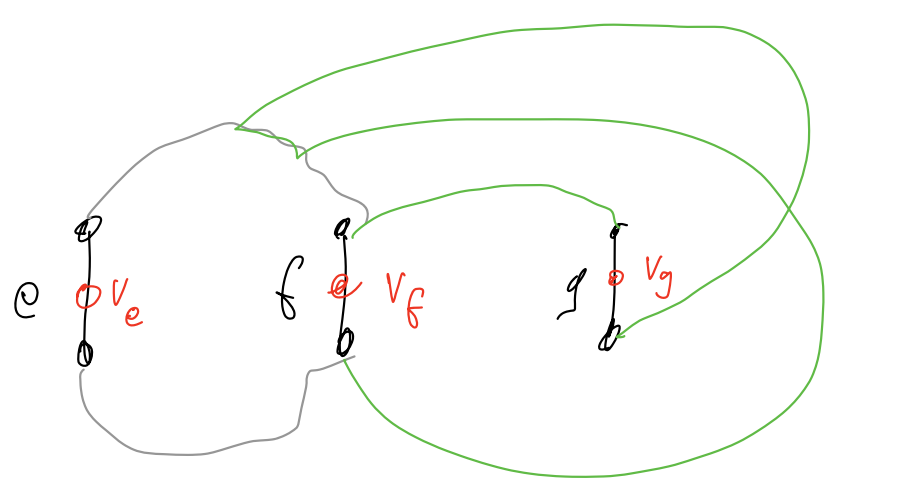
- Assume and
- add vertices
- cannot be separated by removing one edge
- cannot be separated by removing one edge
- cannot be separated by removing one edge
- is 2-edge-connected
- There are two internally disjoint path from to
- There is a cycle between
Blocks
The equivalence classes of this relation are called blocks. A block is a maximal subgraph that is 2-edge-connected. A block is a set of edges.
Block Graph
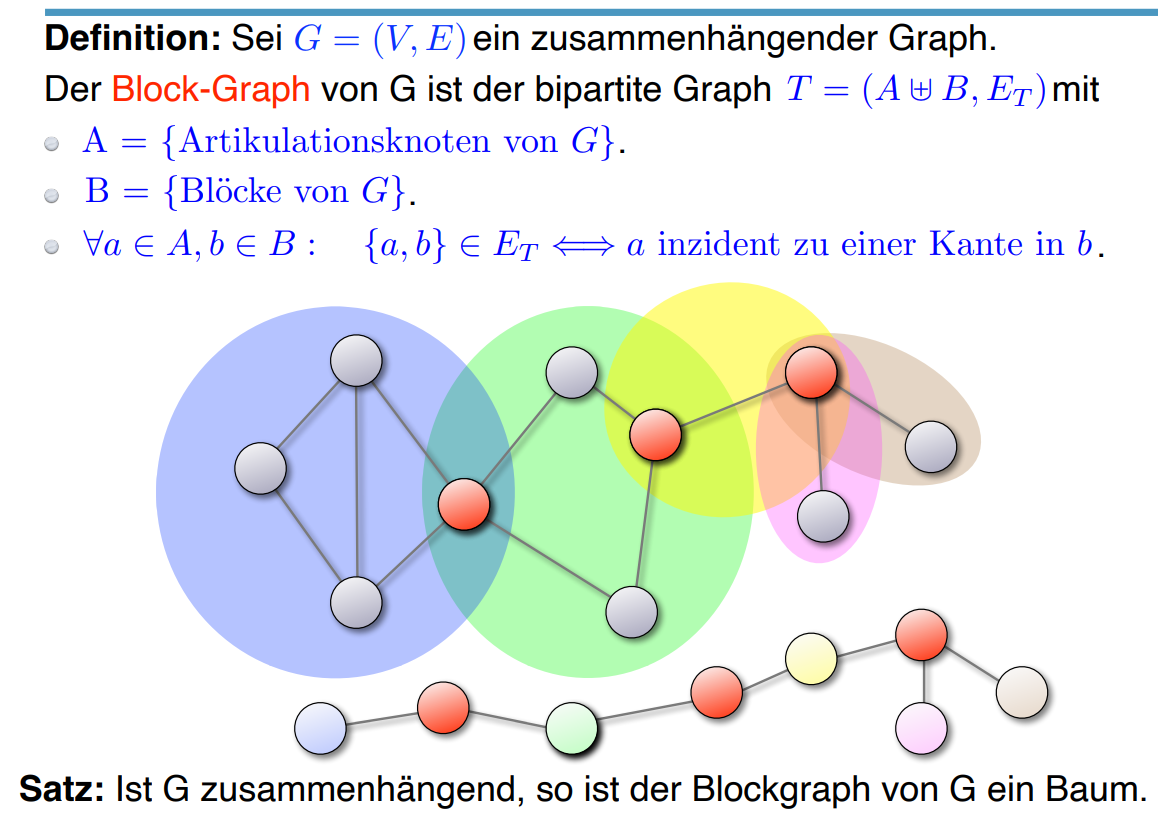 Theorem: If G is a connected graph, its block graph is a tree.
Why is it a tree?
Theorem: If G is a connected graph, its block graph is a tree.
Why is it a tree?
- Connected: The block graph is connected because the original graph G is connected. Every part of G is represented in the block graph.
- Acyclic: Assume, for the sake of contradiction, that the block graph contains a cycle. This cycle would have to alternate between block nodes and cut vertex nodes. A cycle implies that there are at least two distinct paths between two nodes in the block graph. This would mean that at least two blocks share two or more vertices. We already have show that this implies that the blocks should be merged, this contradict the blocks. Therefore, the block graph cannot contain a cycle.
Application
- Large Road Networks
- Bridges and Tunnels
- Route Planning
- Alternative Roads