T1.1 Disjoint Paths
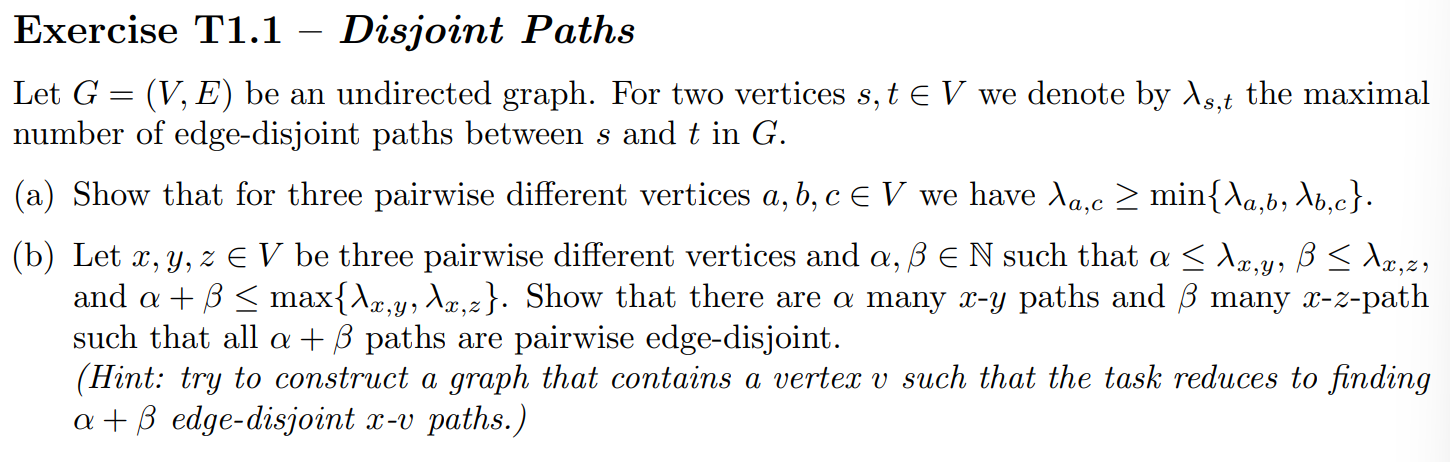 a)
using the edge version of Mengers’s theorem
claim: In the graph , either is disconnected or is disconnected
Suppose both and are connected, then it would mean there is a path from to and a path to . Therefore, we can concatenate those two paths and makes connect. This contradicts the fact that separates
a)
using the edge version of Mengers’s theorem
claim: In the graph , either is disconnected or is disconnected
Suppose both and are connected, then it would mean there is a path from to and a path to . Therefore, we can concatenate those two paths and makes connect. This contradicts the fact that separates
Therefore, every cut (a set of edges that disconnects ) must also either be a cut or a cut. This implies that every . Thus
b) Consider a graph by adding a new vertex to and connect to with parallel edges, to with parallel edges
we first prove that By Menger’s theorem we know
- case 1: does not separates
- are on the side of (connected with )
- are on the side of (connected with )
- are on the side of (connected with )
- case 2: separate
- wlog. we assume that is connected with and is connected with .
- all edges must be in
- where are the original edges of .
- Also, and are separated in . The new vertex and the new edges do not help connect to , so the separation must be achieved by deleting original edges that disconnect from . Therefore,
Since:
- exactly of the paths end via an edge between
- exactly of the paths end via an edge between .
Thus we obtain edge-disjoint paths and edge-disjoint paths that are pairwise edge-disjoint. This proves b)