Edges in Min Cuts
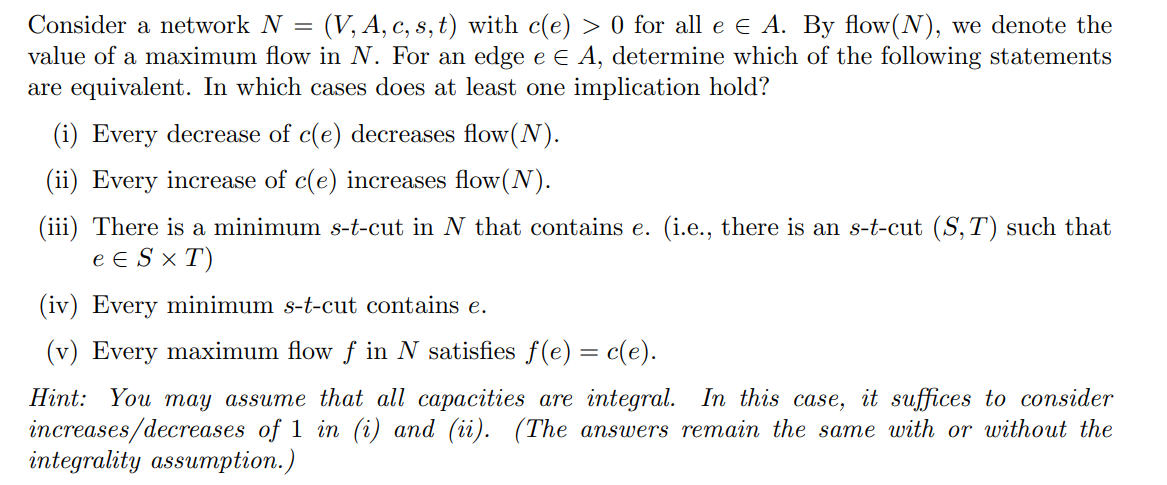
The equivalence classes are
and we have implications
- If no minimum cut contains , then all minimum cuts avoid , so a sufficiently small decrease of leaves those minimum cuts unchanged. The max-flow value does not decrease.
- If a minimum cut contains , then decreasing immediately decreases the capacity of that minimum cut, so the max-flow value decreases. Therefore
- If belongs to some minimum cut , then every maximum flow must saturate every forward edge of that cut. Hence every maximum flow satisfies
- Conversely, if no minimum cut contains , then decreasing slightly does not change the max-flow value. Hence there is still a maximum flow of the original value using less than on , contradicting . Therefore
- If some minimum cut avoids , then increasing does not change the capacity of that cut, so the max-flow value does not increase.
- If every minimum cut contains , then increasing increases the capacity of all current minimum cuts. Since all cuts avoiding were strictly larger before the increase, the max-flow value must increase. Therefore
Implications
Since every minimum cut containing implies that there exists a minimum cut containing ,
using the equivalences before, we have