MIPS is one concrete ISA used by MIPS processors.
MIPS is a classic RISC architecture, which means the instructions are designed to be simple and regular.
Different microarchitectures can implement the same MIPS ISA while preserving the same programmer-visible behavior.
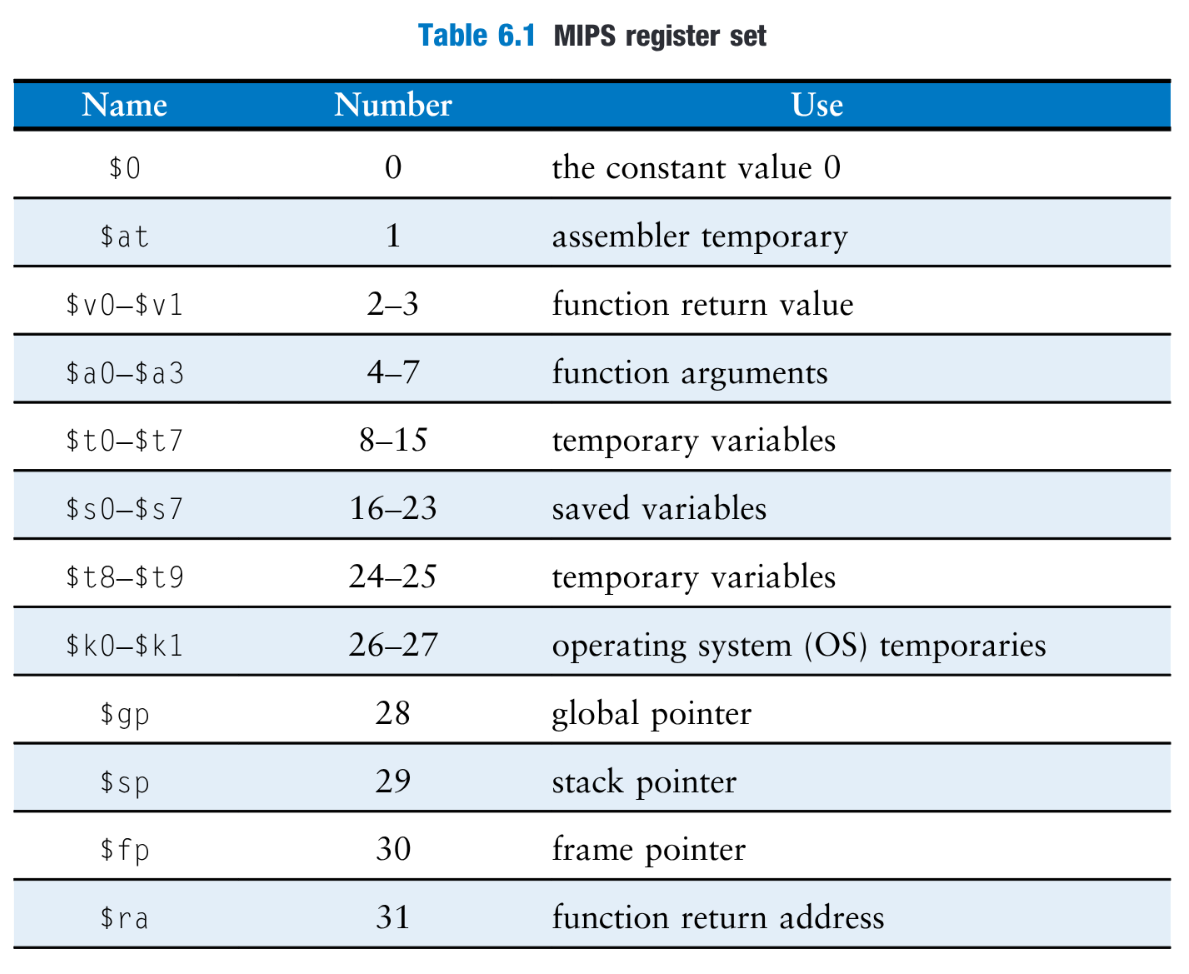
Registers
MIPS has 32 general-purpose registers.
Some common ones are:
$zero: always contains0$t0-$t9: temporary registers$s0-$s7: saved registers$sp: stack pointer$ra: return address
Load/store architecture
MIPS is a load/store architecture:
- arithmetic instructions work only on registers
- memory is accessed only with load and store instructions
Examples:
lw: load word from memory into a registersw: store word from a register into memory
Instruction formats
MIPS instructions are usually 32 bits long.
There are 3 important formats:
R-type
Used for register-register operations such as:
add: adds the values in two registers and stores the result in a registersub: subtracts one register value from another and stores the result in a registerand: performs a bitwise AND on two register valuesor: performs a bitwise OR on two register values
I-type
Used for immediate values and memory access such as:
addi: adds a constant immediate value to a registerlw: loads a 32-bit word from memory into a registersw: stores a 32-bit word from a register into memorybeq: branches if the values in two registers are equal
J-type
Used for jumps:
j: jumps unconditionally to a target addressjal: jumps to a target address and saves the return address in$ra
Example instructions
add $t0, $t1, $t2
lw  $t0, 0($sp)
sw  $t1, 4($sp)
beq $t0, $t1, label
j   target
add $t0, $t1, $t2: computes$t1 + $t2and stores the result in$t0lw $t0, 0($sp): loads the word at address$sp + 0into$t0sw $t1, 4($sp): stores the value in$t1at address$sp + 4beq $t0, $t1, label: jumps tolabelif$t0and$t1are equalj target: jumps directly totarget
Registers