Definition
The Fork/Join Framework is a Java framework for parallelizing divide-and-conquer algorithms using a pool of worker threads and work stealing.
Core idea
The basic pattern is:
- split a large task into smaller subtasks (
fork) - solve subtasks in parallel
- combine the results (
join)
This is especially useful when a problem can be solved recursively.
Main classes
ForkJoinPool: the thread pool that runs fork/join tasksForkJoinTask<V>: base abstraction for tasksRecursiveTask<V>: a task that returns a resultRecursiveAction: a task with no return value
Java also provides a common pool, which is often used by parallel streams and some other concurrency utilities.
Work stealing
The framework uses work stealing for load balancing.
- each worker thread keeps a deque of tasks
- when a worker becomes idle, it steals work from another worker
- this helps keep all processors busy
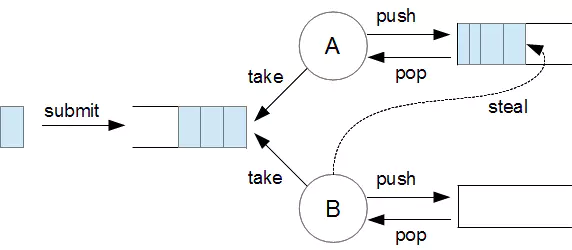 This is one of the main reasons fork/join works well for irregular recursive workloads.
Example
import java.util.concurrent.*;

class SumTask extends RecursiveTask<Long> {
    private static final int THRESHOLD = 1000;
    private final int[] arr;
    private final int left;
    private final int right;

    SumTask(int[] arr, int left, int right) {
        this.arr = arr;
        this.left = left;
        this.right = right;
    }

    @Override
    protected Long compute() {
        if (right - left <= THRESHOLD) {
            long sum = 0;
            for (int i = left; i < right; i++) {
                sum += arr[i];
            }
            return sum;
        }

        int mid = (left + right) / 2;
        SumTask leftTask = new SumTask(arr, left, mid);
        SumTask rightTask = new SumTask(arr, mid, right);

        leftTask.fork();
        long rightResult = rightTask.compute();
        long leftResult = leftTask.join();

        return leftResult + rightResult;
    }
}

ForkJoinPool pool = new ForkJoinPool();
long result = pool.invoke(new SumTask(array, 0, array.length));
Why compute one side directly?
A common idiom is:
fork()one subtaskcompute()the other subtask in the current threadjoin()the forked subtask
This often reduces scheduling overhead compared with forking both sides immediately.
When it is useful
- divide-and-conquer algorithms such as merge sort or quicksort
- tree and graph traversal with mostly independent subtasks
- large array or matrix computations
- CPU-bound tasks that can be split recursively
When it is not ideal
- blocking I/O tasks
- tasks with too much shared mutable state
- extremely small tasks, where scheduling overhead dominates the useful work
If tasks block frequently, worker threads may sit idle and the framework becomes less effective.
Important
Fork/Join is best for CPU-bound, recursive, and mostly independent tasks. It is not mainly a replacement for all multithreading in Java.