15.3 Examples:
NOTE
If G/N has order order of 2, then N must be normal.
15.4 Example
- :(Alternating group) is a normal subgroup of
15.6 Falsity of the Converse of the Theorem of Lagrange
It is false that if d divides the order of G, then there must exist a subgroup H of G having order d
(order 12) contains no subgroup of order 6.
15.7 Example
Compute , where
- The Cosets of H are:
- It is clear that
Summary Let , then , where
15.9 Theorem
A factor group of a cyclic group is cyclic.
15.11 Example
G/H must have an order of 24/2=12 The possible abelian groups of order 12 are , and
has an element of order 4, meaning is the only possible answer, which is isomorphic to (Isomorphism of Cyclic Group)
15.12 Example
Compute
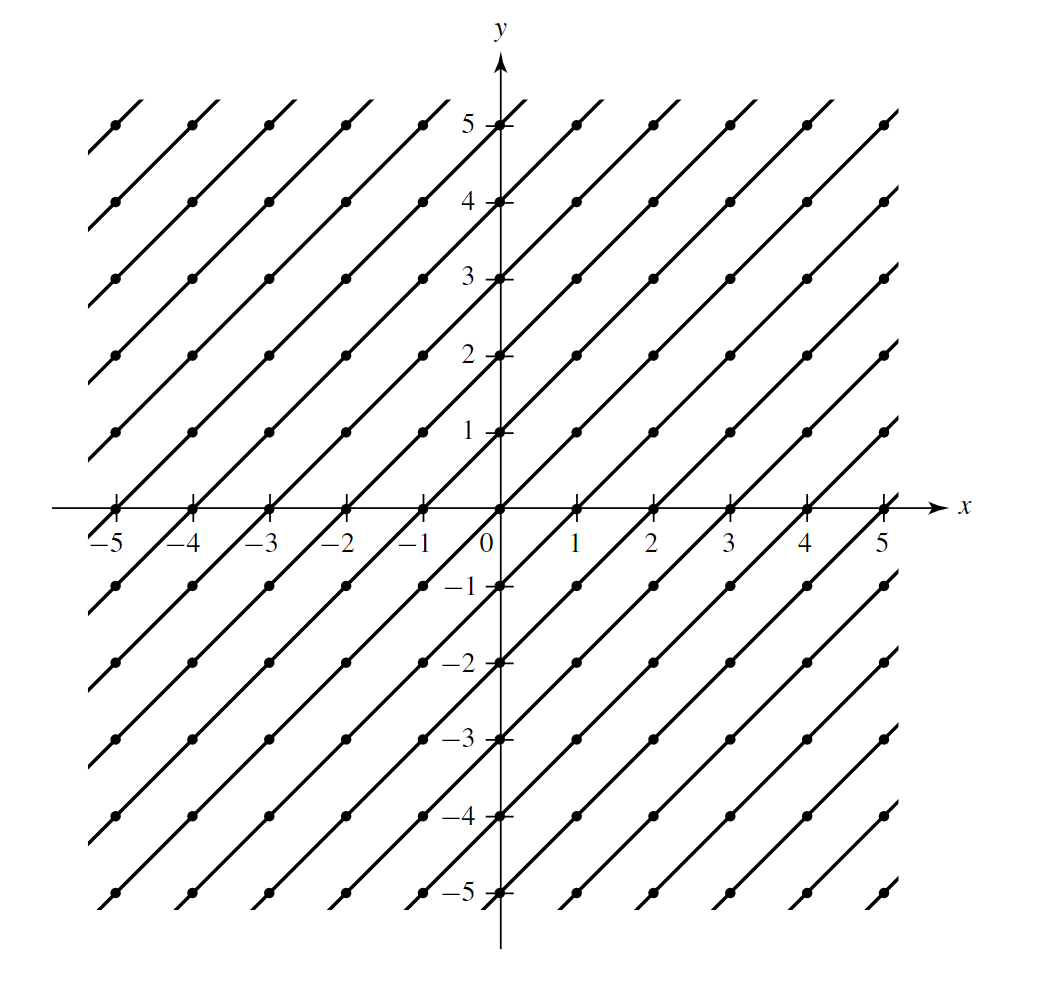 Consider:
- each point as an Element of
- each lines as a coset of or an Element of
- Choose the y-axis as the representatives of the cosets
- The y-axis is isomorphic to
15.14 Definition Simple Groups
A group is simple if it is nontrivial and has no proper nontrivial normal subgroups.
E.g. A group of prime order can have no nontrivial proper subgroups of any sort (The Theorem of Lagrange)
15.15 Theorem
The alternating group is simple for n ≥ 5.
- Proof⏫
15.18 Theorem
M is a maximal normal subgroup of G if and only if G/M is simple.
The Center and Commutator Sub Groups
The Center and Commutator Subgroups
Skipped