Operation notations
is multiplication under modulo 3 is addition under modulo 3 (isomorphism of groups) for for
Uniqueness of the Neutral Element
If is left neutral element and is right neutral element, then
Proof:
- Since e′ is a right neutral element, e∗e′=e.
- Since e is a left neutral element, e∗e′=e′.
Monoid
Definition
A monoid is an algebraic structure consisting of a set M, a binary operation ∗, and a neutral element e, satisfying the following properties:
- Associativity: For all , .
- Neutral Element: There exists an element such that for all , .
- Closed We denote a monoid as .
Example: Monoid of Bitstrings
Consider the set of all finite bitstrings, denoted by , along with the concatenation operation , and the empty bitstring ϵ. This forms a monoid:
- Associativity: Concatenation is associative. For example, is the same as .
- Neutral Element: The empty bitstring ϵ acts as the neutral element for concatenation. For any bitstring , .
Overview
Algebra Structure
Link to original
Inverse
The algebra we work on must have an neutral element at first
- Left Inverse: An element is a left inverse of a if , where is the neutral element.
- Right Inverse: An element is a right inverse of a if .
Lemma 5.2 If an element has both a left inverse and a right inverse , and the operation is associative, then and must be the same.
Proof: (neutral element) (c is the right inverse) (associativity) (b is the left inverse) (neutral element)
Groups
Definition
A group is an algebra , if is a monoid and every has an inverse
Other definitions
Definition: Group - normal definition
A group is a set , with a operation , such that the following axioms are satisfied:
Link to original
- The set is closed under
- associativity of
- identity element e for
- Every element in is invertible
Formalized
- associativity:
- identity element:
- (simplified)
- inverse:
- (simplified)
Proof: prove that the simplified version is still sufficient
Examples
when is prime (see Number Theory > Multiplicative Inverses)
Transclude of number-theory#multiplicative-inversesexample
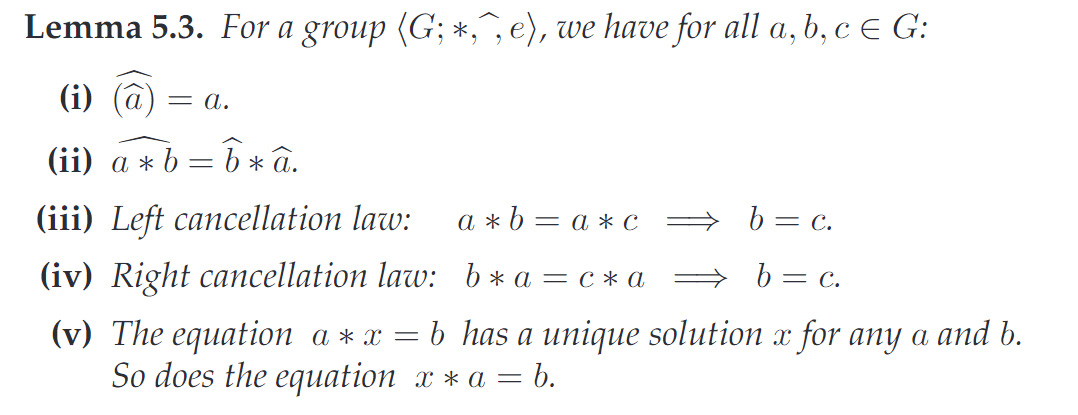
Lemma 5.3
An Important example: Permutation Groups
: the set of permutations of elements OR the set of bijections
Applications
- RSA Public Key Encryption