Definition: Isometry
NOTE
An isometry is a transformation that preserves distance.
More formally, a function between metric spaces is an isometry if for any two points and , there is
This includes Translation, Rotation, Reflection, glided Reflection (the only four)
Cartan–Dieudonn´e theorem
Reflection representation of isometries
Any isometry of that fixes is the product of at most reflections in hyperplanes through
Proof by Induction For : the map is the only isometry that fixes in For : Suppose the statement is true for Let be an isometry of fixing for some and with Then we can use a hyper plane between and that reflects to (we let the axis on be , and the reflection be ) The map maps back to in the subspace (linear) and becomes a identity map in this subspace. Since the restriction of on can be represented as reflection (proved by induction), the isometry must can be represented as reflections.
Generalization
This theorem can be generalized to complex numbers and even finite fields
Special case: rotations as reflections
NOTE
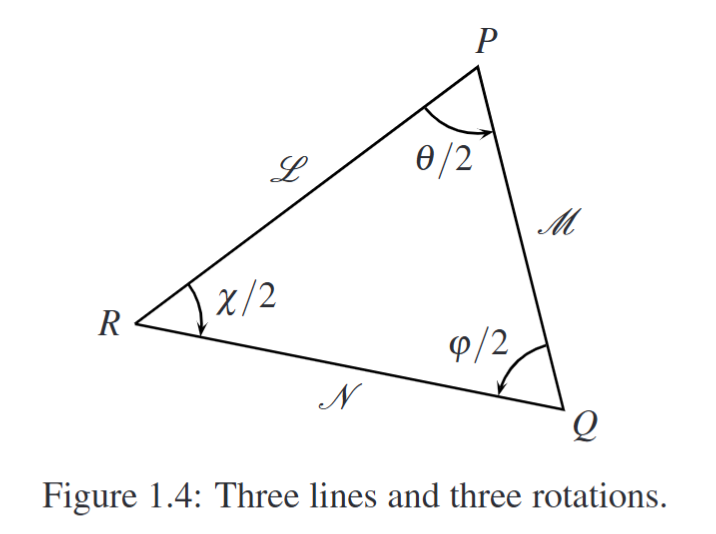
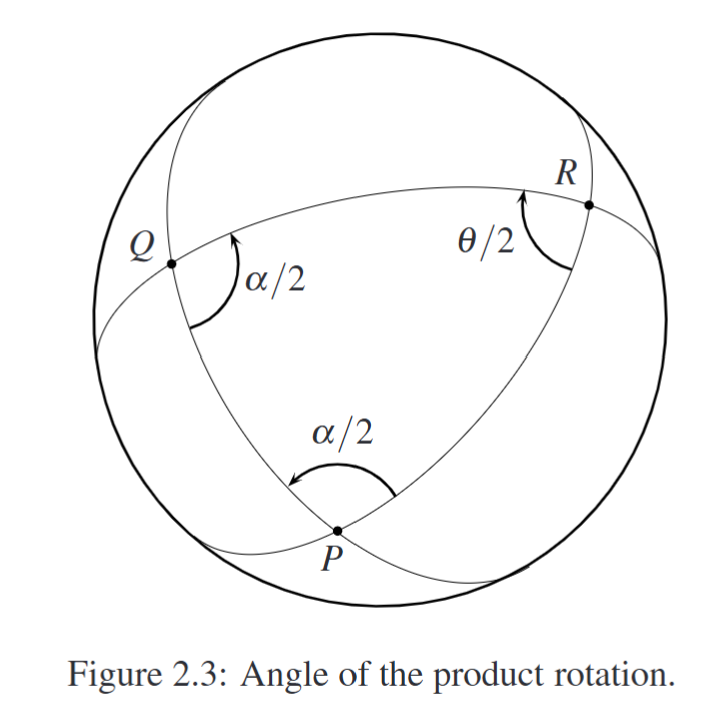
Rotation about a point(2D)/an axis(3D (through O)) through angle can always be seen a composition of two reflections of any two axis that meet at angle
This can be easily proved by plane geometry.
Observation
The red reflections are the same as the blue reflections, since opposite reflections cancel out.reflection and rotation.excalidraw
⚠ Switch to EXCALIDRAW VIEW in the MORE OPTIONS menu of this document. ⚠ You can decompress Drawing data with the command palette: ‘Decompress current Excalidraw file’. For more info check in plugin settings under ‘Saving’
Excalidraw Data
Text Elements
Embedded Files
c826ada662eabc7ca631ba6b7822a3452d3391db: Pasted Image 20260702143115_500.png
a7bd80304255574f69d3cd4863566a99c278e9fb: Pasted Image 20260702143224_279.png
Link to original