Overview
is the rotation group of
Subgroups
Other than the obvious subgroup , there are also three other subgroups called the polyhedral groups (induced by the rotations that map regular polyhedron into itself)
They are:
- Tetrahedral group () - order 12
- Octahedral group () - order 24
- Icosahedral group () - order 60
The order of these groups can be calculated in the following way: a position of a such polyhedron is uniquely determined by:
- Which of the faces is in the position of the front face
- Which of the edges of that face is at the bottom of the front face
Therefore, we get for example 4 faces 3 edges each face
Simplicity
SO(3) is a simple group
SO(3) is a simple group The only nontrivial subgroup of SO(3) closed under conjugation is SO(3) itself
Proof: suppose is a nontrivial rotation of a nontrivial normal subgroup , then includes . Let’s say rotate about through angle Consider the geometric meaning of this conjugate, can be seen as a transformation of the rotation axis, then must contain all possible rotations through angle
Now consider the composition of two rotations with angle (see Reflection representation of isometries). This composition can be seen as a rotation through angle
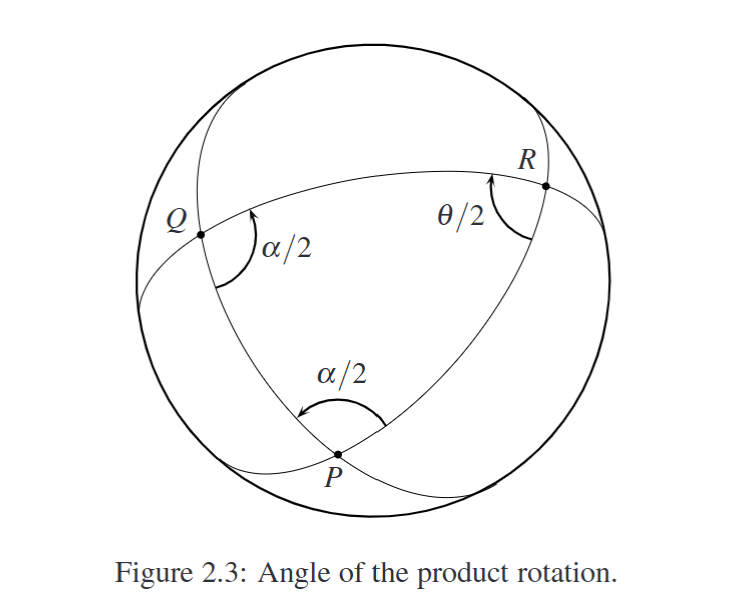 We see that by moving we can obtain rotations with any angle ()