NOTE
A relation is a special set
Inverse of Relation
The inverse of a relation from to is the relation from to defined by
Eigenschaften von Relation
Eigenschaften von Relation auf :
- reflexiv:
- symmetrisch:
- antisymmetrisch:
- transitiv:
Transitive Closure
Equivalence Relations
An equivalence relation is a relation on a set that is reflexive, symmetric, and transitive.
Example
is an equivalence relation on
equivalence relation example.excalidraw
⚠ Switch to EXCALIDRAW VIEW in the MORE OPTIONS menu of this document. ⚠ You can decompress Drawing data with the command palette: ‘Decompress current Excalidraw file’. For more info check in plugin settings under ‘Saving’
Excalidraw Data
Text Elements
-3
6
0
10
7
Link to original
Equivalence class
each group of elements circled in red is a equivalence class
Circular transclusion detected: Excalidraw/equivalence-relation-example.excalidraw
Example
The equivalence classes of
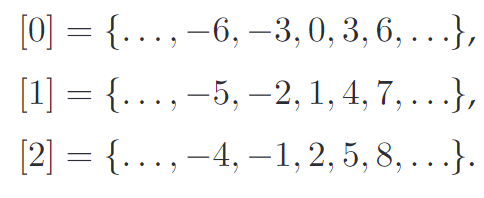
Partition via equivalence relations
The quotient set of by , or simply A modulo or mod
This concept is similar to factor group and factor rings
| Context | Relation type | Quotient object | Categorical role |
|---|---|---|---|
| Set | Equivalence relation | Partition ( ) | Coequalizer in |
| Group | Normal subgroup ( ) | Factor group ( ) | Coequalizer in |
| Ring | Ideal ( ) | Factor ring ( ) | Coequalizer in |
Example
Consider and define as is an equivalence relation
- reflexive:
- symmetric:
- transitive:
- If
- then and
- If
- then
And now we can define the set of rational numbers
Definition of the rational numbers
Intersection of equivalence relations
The intersection of two equivalence relations (on the same set) is an equivalence relation.