14.1 Definition Factor Group
Let be a normal subgroup of We first divide into several partitions or formally cosets (written in the form with , presenting ). Each partition has “size” , and the set of all cosets forms a new group denoted as . This group has
- Identity:
- Inverse:
- Operation:
From the view of homomorphism
Let Let , The set of all cosets of H is denoted by (read as G over H or G modulo H)
- There exists a one-to-one relationship between and the elements of the group . 13.15 Theorem
- and have same amount of elements. Thus there is a onto relationship 13.15 Theorem
- A homomorphism exist: Definition of Homomorphism if and and Then is isomorphic to
Definition
is called as a factor group (quotient group) or more precisely factor group of G modulo H
Tip
H can also be any normal subgroup subgroup of , otherwise we cannot form a factor group
14.2 Example
The factor Group is isomorphic to
Taking the example from 3Z Let
Computation in factor group
find any element from two cosets. calculate using the operation in , and the result lies in the coset that is the product of the original two cosets.
NOTE
congruent modulo H: Elements in the same coset of H
Let H be a subgroup of G This is well defined(independent from the choice of ) if and only if H is a normal subgroup of G
Tip
- because left coset is the same as the right coset (see normal group)
- because H is a group
The Fundamental Homomorphism Theorem
[[Math/ Books/A First Course in Abstract Algebra.pdf#page=145&selection=166,1,264,1&color=note|p.140]]
Let be a group homomorphism with kernel . Then is a group, and given by is an isomorphism.
If is the homomorphism given by , then for each .
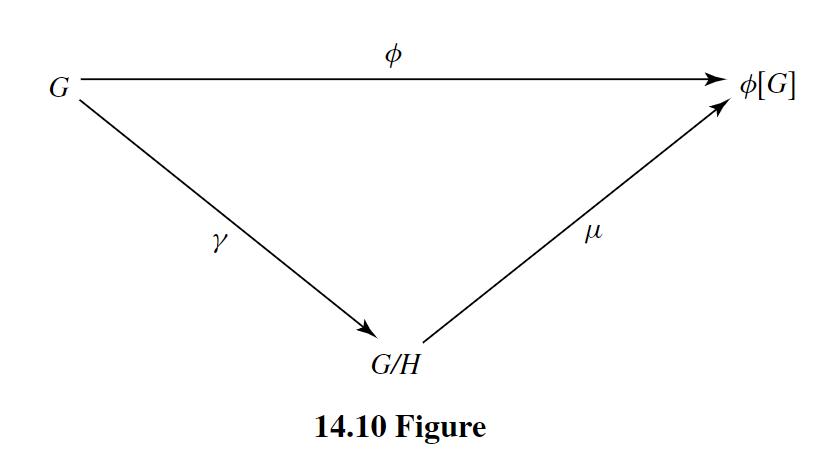
Let H be a normal subgroup of G. Then is a homomorphism with kernel H.
-
Proof 14.9🔽
-
is an isomorphism of G/H with 14.1 Definition Factor Group
-
is an homomorphism of G with G/H
14.12 Example
Classify the group
Warning
is not isomorphic to See Fundamental Theorem of Finitely Generated Abelian Groups
- Let G be , and H be
- Find a homomorphism from to (Here to ) that has the Kernel .
- According to The Fundamental Homomorphism Theorem is isomorphic to
A general construction method of classification
- Step 1: Write in its decomposition as a direct sum of cyclic factors:
-
Step 2: Describe how sits inside this decomposition, i.e., which factors or subcycles of factors it occupies.
-
Step 3: Construct a projection (or combination of projections)
by “discarding” the factors corresponding to and keeping the remaining factors, ensuring
- Step 4: By the First Isomorphism Theorem, conclude
- Step 5: If needed, adjust into standard form as a direct sum of cyclic groups:
where .
14.14 Example
NOTE
Every subgroup H of an abelian group G is normal
14.15 Definition: Automorphism
[[Math/ Books/A First Course in Abstract Algebra.pdf#page=146&selection=590,1,678,1&color=note|p.141]]
- An isomorphism of a group with itself is an automorphism of .
- The automorphism , where for all , is the inner automorphism of G by g.
- Performing on x is called conjugation of x by g.
- if for all , H is a normal subgroup
- Definition of conjugate subgroup: Given a group and a subgroup , for any define
The set is a subgroup of , called a conjugate subgroup of .
- Isomorphism Property: The map is a group isomorphism.
NOTE
Hence every conjugate subgroup is isomorphic to .
See how Automorphism is defined in Category Theory: Definition: Automorphism
Ways to Prove is a Normal Subgroup - Summary
- for all and .
- for all .
- for all
- for all . See Ways to Prove H is a Normal Subgroup