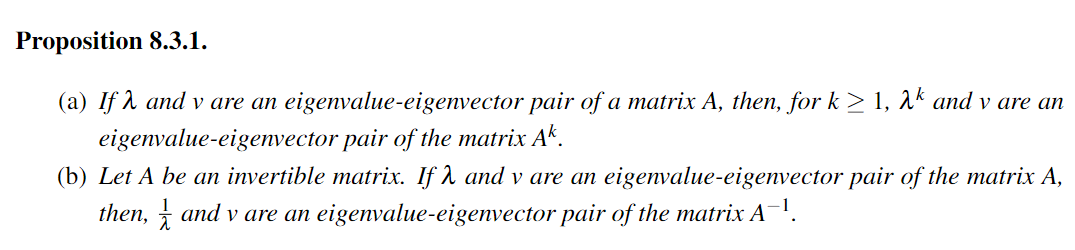
Find v∈Rn∖{0} with Av=λv(λ,v) is an eigenvalue-eigenvector pair
Useful fact
Eigenvalues of (abba) are a±b
Example: Fibonacci numbers
g0=(10)gn=Mng0=(Fn+1Fn)=[1110](FnFn−1)
We find the eigenvalues of M and the corresponding eigenvectors
[M−λI] has a not trivial null space
⟹[M−λI] not invertible
⟹det(M−λI)=0det[1−λ11−λ]=λ2−λ−1=0λ1=21+5,λ2=21−5 (Golden ratio)
For λ1:
(00)=[1−λ111−λ1]((v1)1(v1)2)v1=(21+51)v2=(21−51)⟹span(v1,v2)=R2g0=(10)=α1v1+α2v1⟹α1=51,α2=−51gn=Mng0=Mn(51v1−51v2)=51Mnv1−51Mnv2=51λ1nv1=51λ2nv2
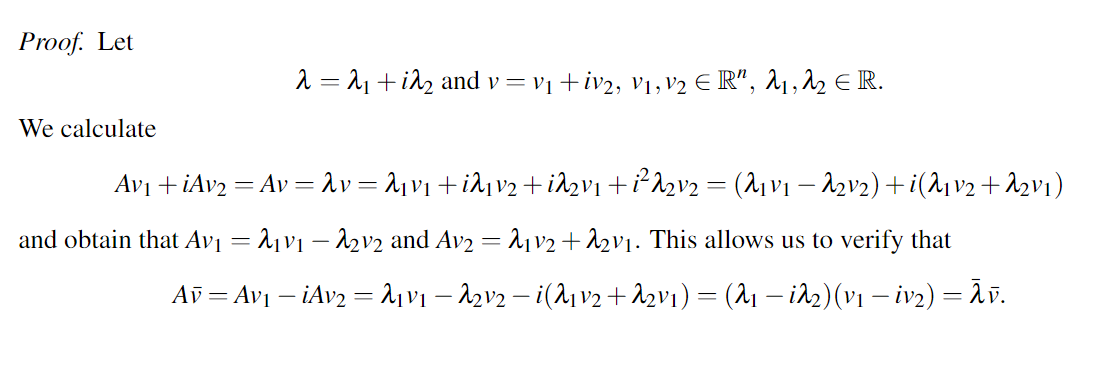
If (λ,v) is an eigenvalue-eigenvector pair, then (λˉ,vˉ) is an eigenvalue-eigenvector pair.
Lemma 8.3.6
Let A∈Rn×n and λ1,…,λn its eigenvalues. (λ can be a complex number)
det(A)=∏i=1nλi
Tr(A)=∑i=1nλi
Proofdet(A−λI)=P(λ)=0 (the characteristic polynomial)
det(A−λI)=∑σ∈∏nsgn(σ)∏i=1n(A−λI)i,σ(i)=(a11−λ)(a22−λ)…(ann−λ)+exponent ≤n−2a14(a22−λ)(a33−λ)a41⋯+…. (If we do not use the identity σ, then we must have at least two elements not on the diagonal)
PA(λ)=cnλn+cn−1λn−1+⋯+c0=(−1)nλn+(−1)n−1Tr(A)(a11+a22+⋯+ann)λn−1+⋯+det(A)c0 (*)
Note that PA(0)=c0=det(A−0I)=det(A)
Now consider PA as product of roots
PA=cn(λ−λ1)(λ−λ2)…(λ−λn)PA=(−1)n(λ−λ1)(λ−λ2)…(λ−λn) (from *))
expands:
PA=(−1)nλn+(−1)nλn−1(−λ1−λ2−⋯−λ)+⋯+(−1)n(−1)n(λ1λ2…λn)PA=(−1)nλn+(−1)n(−∑i=1nλi)λn−1+⋯+∏i=1nλi⟹c0=∏i=1nλi=det(A)⟹(−1)⋅−∑i=1nλn−1=Tr(A)⟹∑i=1nλi=Tr(A)