GPT5.2
Certain “nice” linear operators can be understood by decomposing the space into spectral components (generalized eigenspaces), so the operator acts like multiplication by a scalar on those components.
Theorem
NOTE
Any symmetric matrix has real eigenvalues and an orthonormal basis of consisting of its eigenvectors.
Proof (Induction) There are orthonormal eigenvectors von Base case : if an eigenvalue of , then (we can normalize this ): Let be an eigenvector of . We have .
Since is real symmetric we have . Thus, Since , then .Hermitian conjugate
Let with
Link to original
Induction steps
orthonormal eigenvectors with real eigenvalues
Let a orthonormal basis of
Define
is orthogonal
Let ( is symmetric)
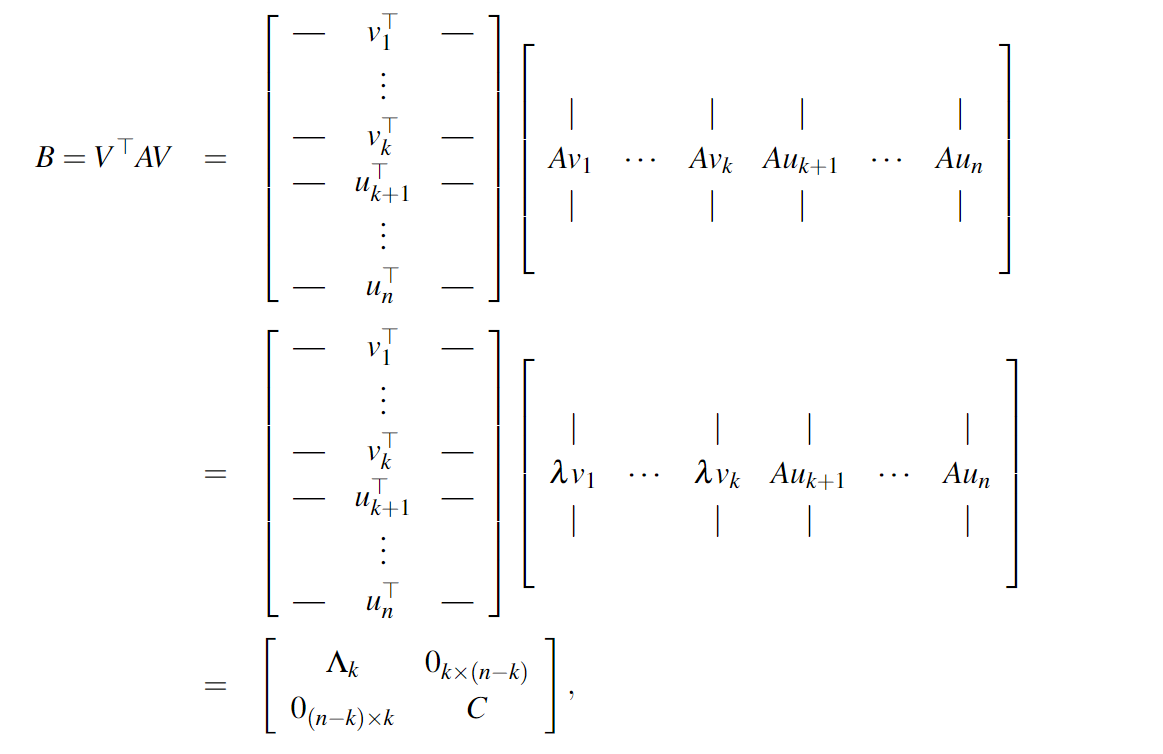 is symmetric
has a real eigenvalue with eigenvector
Let
is eigenvector of (under matrix )
is symmetric
has a real eigenvalue with eigenvector
Let
is eigenvector of (under matrix )
Define Finally we normalize such that Now we proved that there is always real orthonormal eigenvectors
Corollary 9.2.2
For any symmetric matrix , there exists an orthogonal matrix such that
Corollary 9.2.4
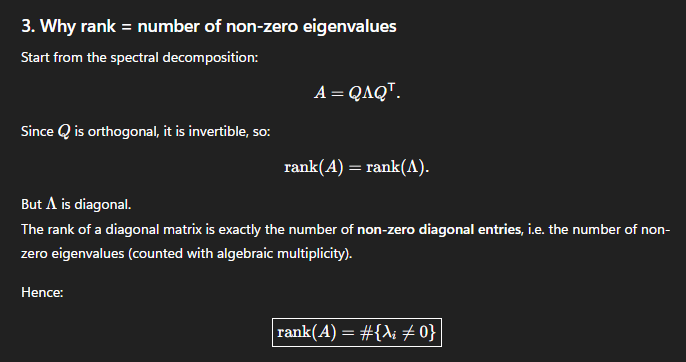
The rank of a real symmetric matrix A is the number of non-zero eigenvalues (counting repetitions)
Proposition 9.2.10 (Rayleigh Quotient)
Given a symmetric matrix the Rayleigh Quotient defined for is
NOTE
The Rayleigh Quotient gives the corresponding eigenvalue of a eigenvector
How do we get this quotient
we have . is given, and we want to find . However, we cannot divide on both sides, because vector division is not defined. We multiply both side by first
Warning
Even if is not an eigenvector, the quotient is still defined, but does not generally give an eigenvalue.
In fact there is for all non-zero
Lemma 9.2.7
Let be a symmetric matrix and be two distinct eigenvalues of with corresponding eigenvectors . Then and are orthogonal.