Two subspaces and are orthogonal if for all and , the vectors and are orthogonal
Lemma 5.1.2 To prove this we only need to prove that the basis of the two subspaces are orthogonal to each other. The basis are denoted as and In such case the set are linearly independent.
Proof Consider the linear combination
we want to show that and
define
then
then Since , this means
Hence, we get
Since and are linear independent vectors, and for all
This means form the basis of a new subspace denoted as and we must have
Examples
If are orthogonal, then
Fact 1
orthogonal orthogonal subspaces
Fact 2
are linear independent are basis of and we can decompose as (MinKonski sum)
Lemma 5.1.3

Orthogonal Complement
Definition: Orthogonal Complement
Theorem 5.1.6
Important
of course
Show Let (meaning ) By definition if then Lets write as for all (recall the definition of column space Column space) (recall the rules of transpose Transpose (Transposition))
Show Let By definition again we write as for some Let’s choose (which is a valid vector in : Then so
Hence the theorem is proved
Example
Find Just find or
Example 2
Let a subspace dimension: Theres is with Therefore,
If we let be a matrix, then
is the null space of the matrix A, and it is a hyperplane
Theorem 5.1.7
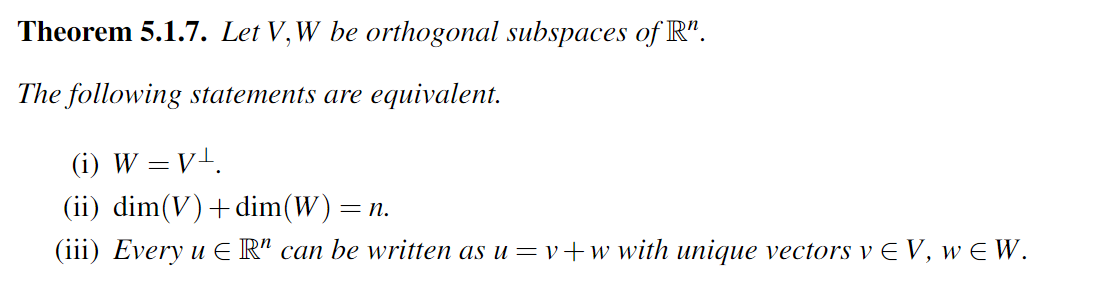
Proof: Let be basis from , and let be basis from Let We know
…
since is orthogonal to show …
Lemma 5.1.8
NOTE
Lemma 5.1.10
Title
and
Proof: then
then
Example