Notations
Method: Gauss elimination
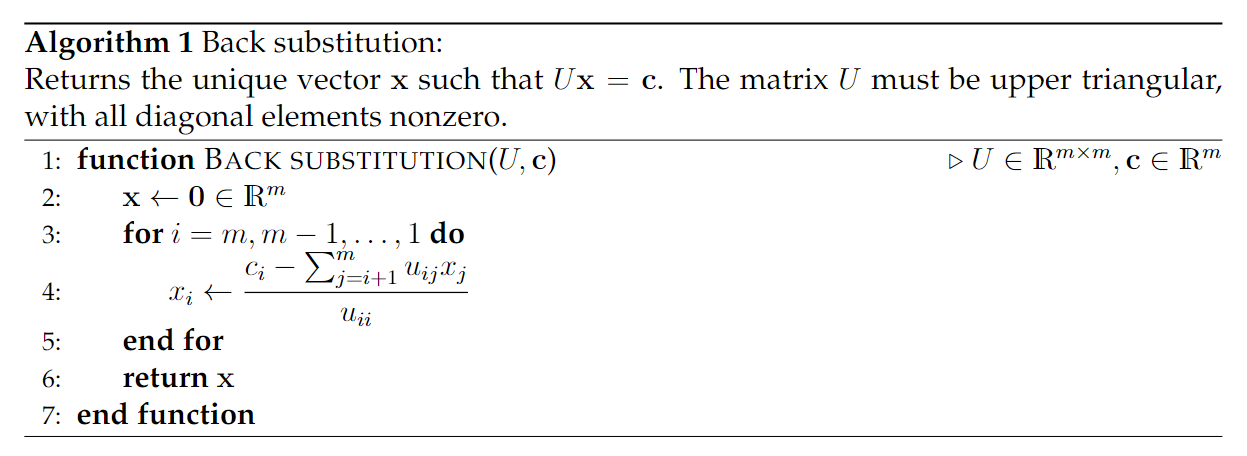
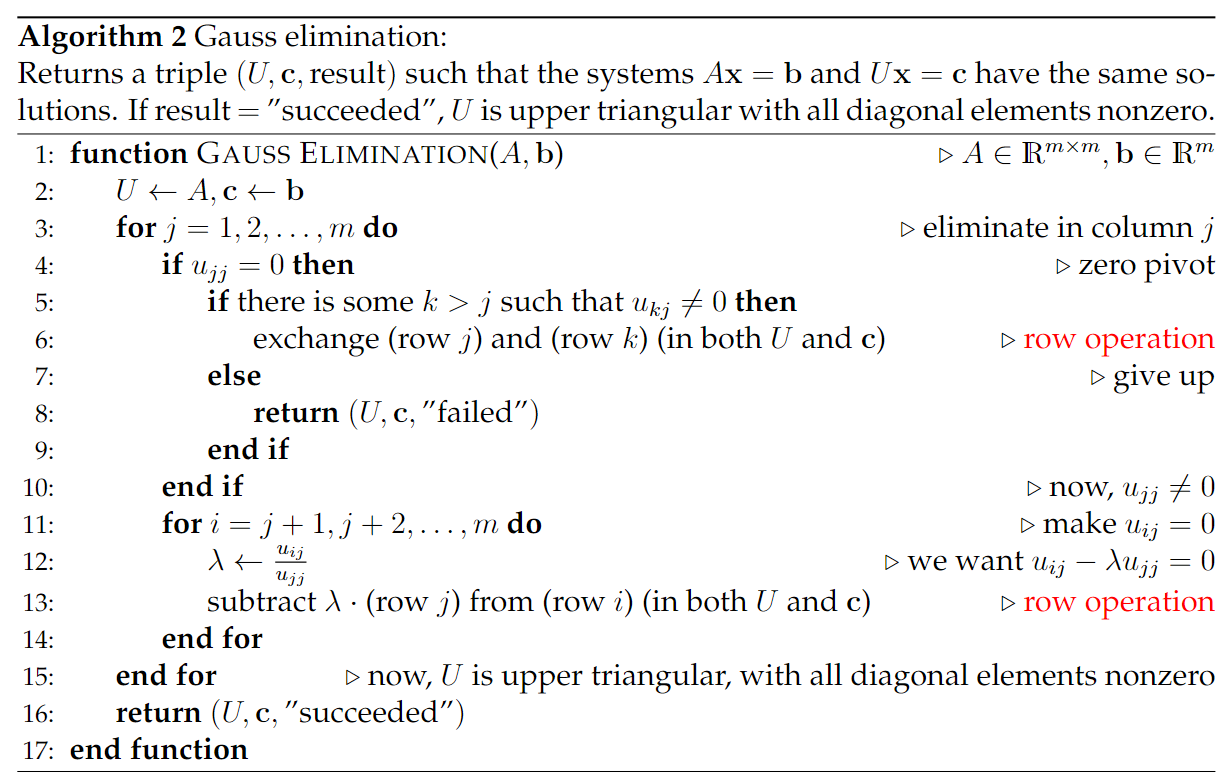
Gaus elimination succeeds The columns of are linearly independent
Method: Gauss-Jordan Elimination
All solutions of
Definition: The solution space
It’s obvious that (see How to compute null space)
and is just a shifted null space
visualization of a shifted null space
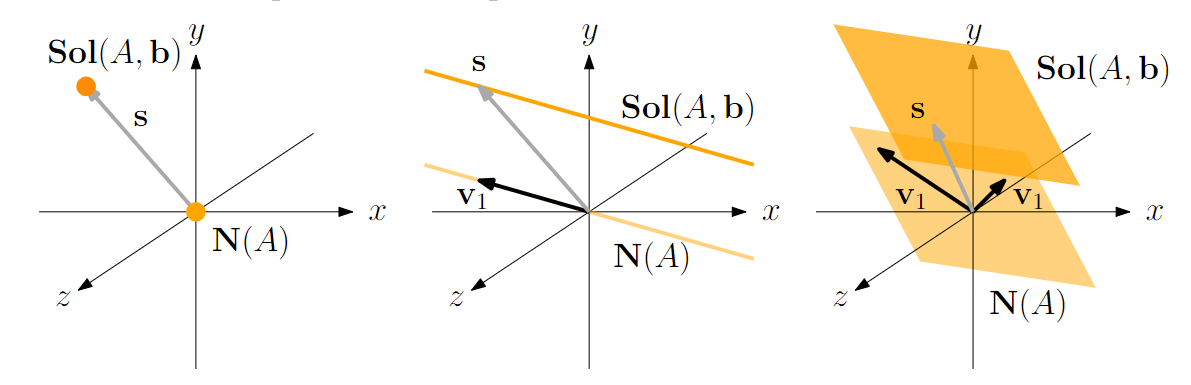 Thus,
Thus,
To solve , we just compute one solution using Gauss-Jordan Elimination and a basis from . Then
Generally, a shifted copy of a subspace in a vector space is called an affine subspace
Theorem 6.2.2
Suppose is not empty where is unique such that
Now we know that we can find a unique vector that can represent The vector is orthogonal to the (the shortest position vector)
- Proof
Edge case
Question
What if is empty?
Let Consider the equation is linear independent from The equation has a solution if
Let , Proof: and can have a same solution and
Proof: with This means Let
Application: Row Independent Equation Systems
If and the rows are linear independent: is solvable for all Proof:
Application: Projection System
is always solvable for all Proof: (See Lemma 5.1.10)
Dimension of the solution space
If has a solution, then has dimension , since
Lemma 6.2.1
**Proof**: $x \in C(A^{\top}), y\in C(A^{\top}) \implies x-y\in C(A^{\top})$ $Ax=Ay\implies A(x-y)=0\implies x-y\in N(A)\implies x-y \in C(A^{\top})^{\perp}$ $(x-y\in C(A^{\top}))\wedge (x-y\in C(A^{\top})^{\perp})\implies x-y=0\implies x=y$ ## Certificate $A\in \mathbb{R}^{m\times n},b\in \mathbb{R}^{m},A=\begin{bmatrix}a_{1}^{\top} \\ a_{2}^{\top} \\ \vdots \\ a^{\top}_{m}\end{bmatrix}$ $a_{i}^{\top}\in \mathbb{R}^{n}$, consider $P=\{ x \in \mathbb{R}^{n}|a_{i}^{\top}x\leq b_{i}, \;i \in[m]\}=\{ x \in \mathbb{R}^{n}|Ax\leq b\}$ ### Theorem: Farkas $P=\{ x \in \mathbb{R}^{n}|Ax\leq b\}=\varnothing\Longleftrightarrow \{ z\in \mathbb{R}^{m}|A^{\top}z=0,b^{\top}z=-1,z\geq0 \}$ OR formally ![[Pasted image 20251114115652.png]]Let . Let . We have$$ Ax=Ay\Longleftrightarrow x=y