Example: Gluing a segment
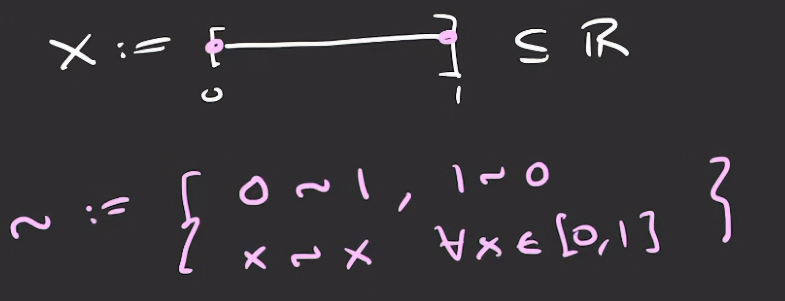 By defining the endpoints as being in the same equivalence class, we basically connect the endpoints and the resulting quotient space is homeomorphic to a circle.
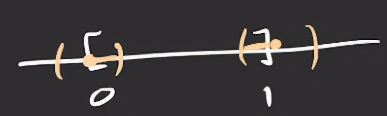 Consider this orange subset, it is open (see Subspace) and includes and , so on our quotient space, the corresponding set must also be open.
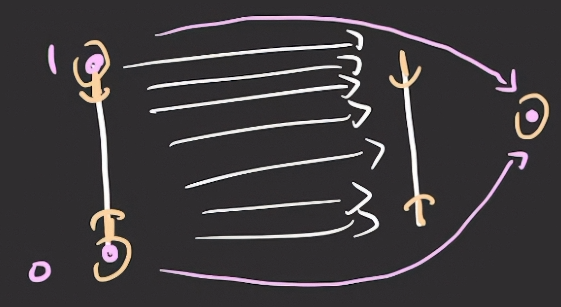 A better way to draw this quotient space is of course to draw a circle
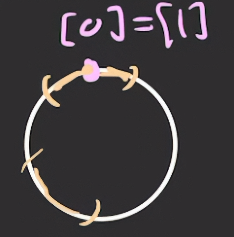
Here we have the quotient map
we check that
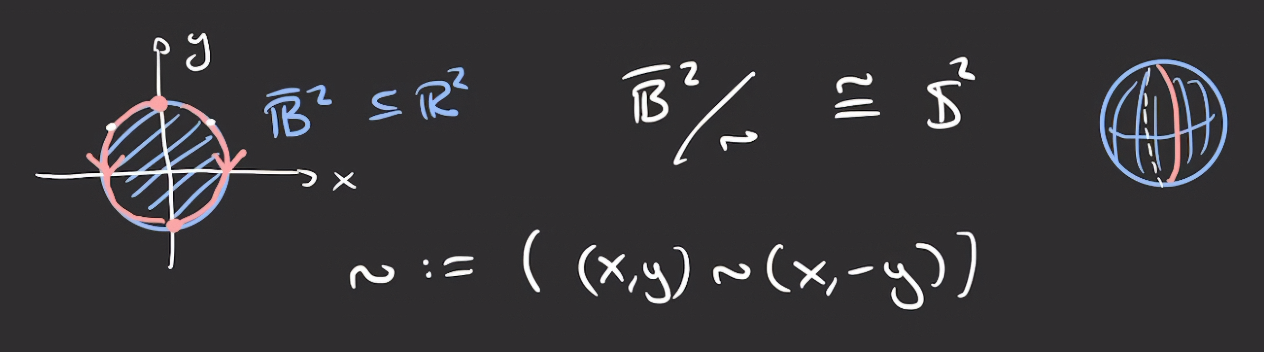
Example: glue ball into sphere
Consider a closed disk (2-dimensional ball) ,
and an equivalence relation
We get
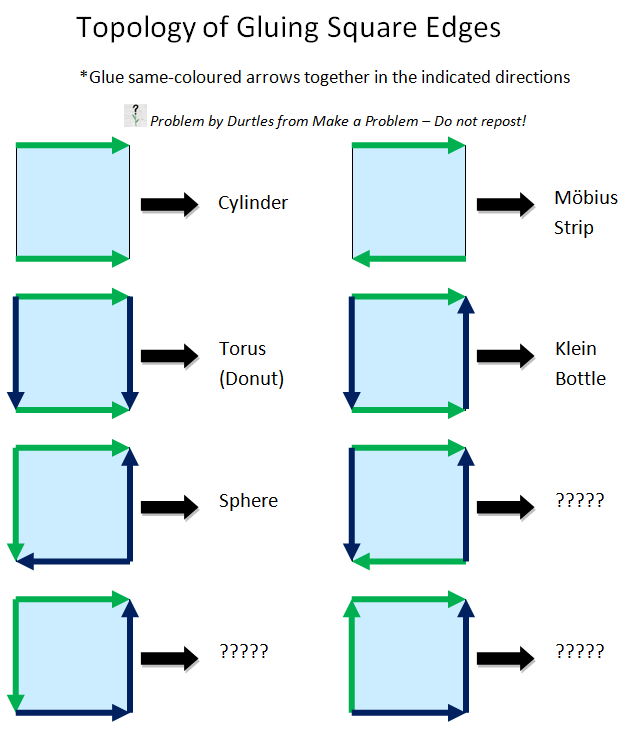
Example: gluing square edges
Cone on a space X
Let be a space
Consider the product space
we define
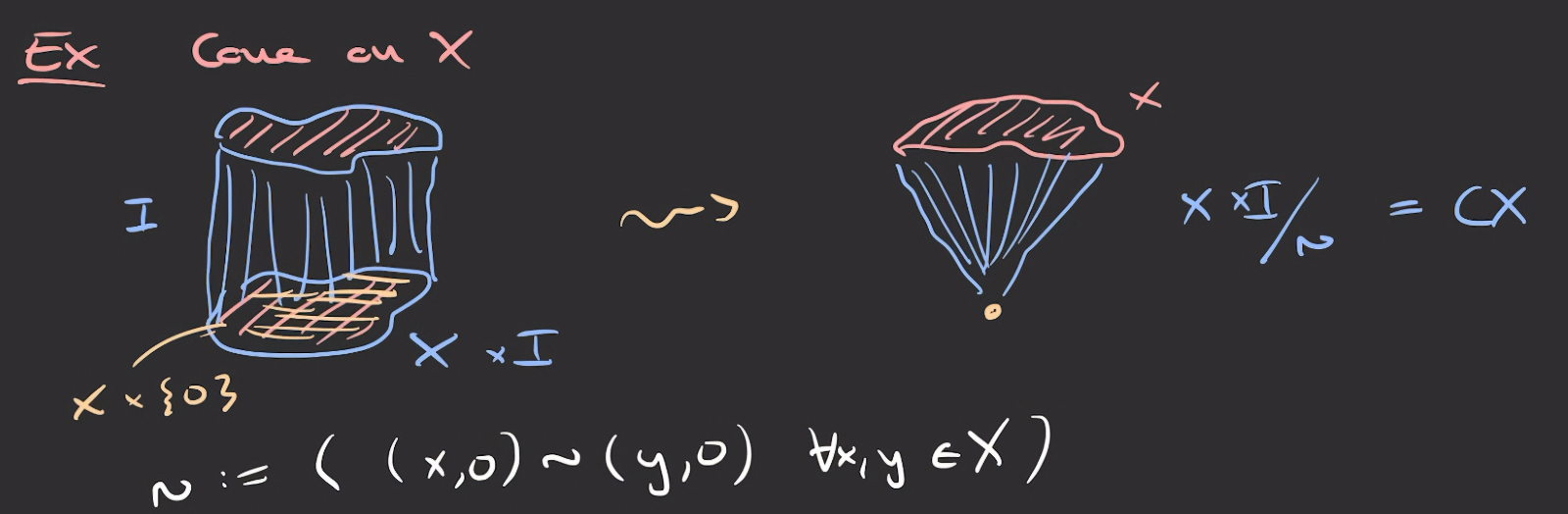
We denote
NOTE
we also have Whether the “vertex” is inside of the sphere or outside of the sphere does not matter
We have here a quotient map
Wedge sum
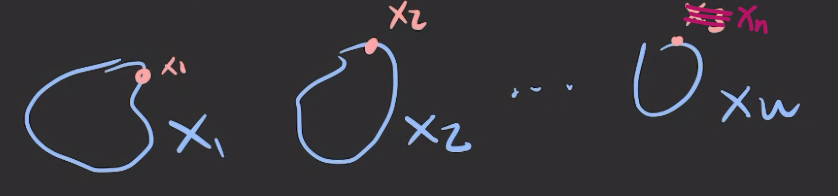 We then define the wedge sum as
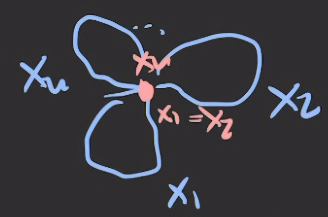 In the case of having only two spaces we have:
This can also be viewed as a Adjunction Space
In the case of having only two spaces we have:
This can also be viewed as a Adjunction Space
Example: Normalization
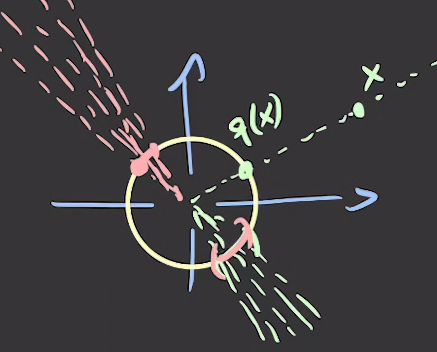
Example: R/Z
Let
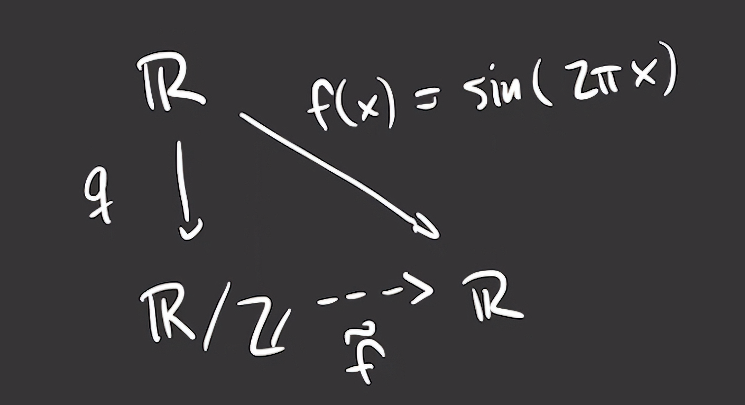
To define we only need to have using universal property. This is indeed true (easily checked) So there is an unique continuous to make the graph commute
To find for example we can just find an element of the preimage of in , and find . In this case let’s choose , and gives . When we choose , then still gives 0.
Actually is homeomorphic to
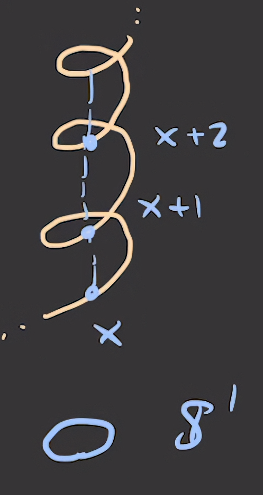
To show is homeomorphic to :
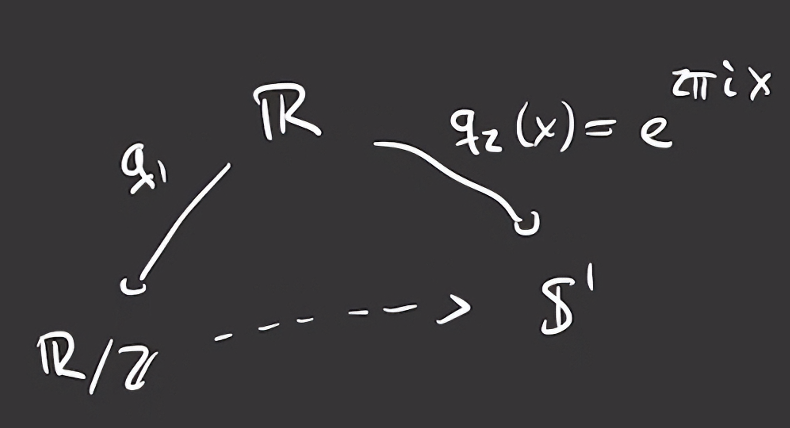 Note that we have (Example Gluing a segment)
By using uniqueness of quotient maps we can clearly see that
Note that we have (Example Gluing a segment)
By using uniqueness of quotient maps we can clearly see that