Definition
Let be a space, a set and a surjective function (the quotient map). Define the quotient topology on by setting open open in .
so if a map is continuous, surjective, and open or closed, then it is a quotient map.
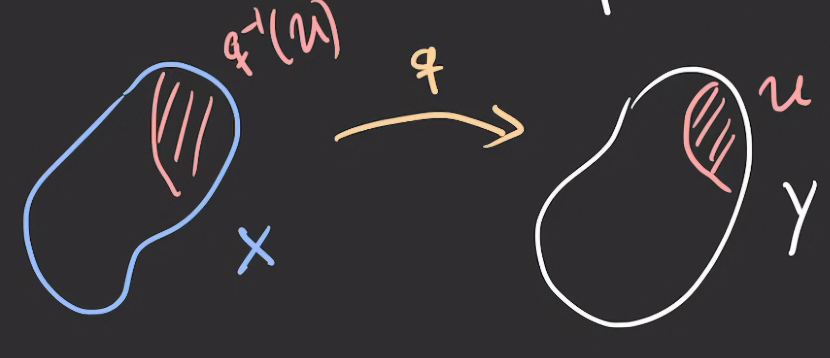
The function is of course always a continuous map. The quotient topology is also clearly the largest topology we can put on such that is going to be continuous. Since all open sets on is mapped to the open sets on , we cannot have an extra set on the quotient topology, otherwise this extra set’s preimage will not be open and will not be continuous.
We can prove that the quotient topology is indeed a topology: for “Closed under unions”: Let open, by property of preimage. Thus arbitrary union of is open. analogously,
Different way to think of a quotient space
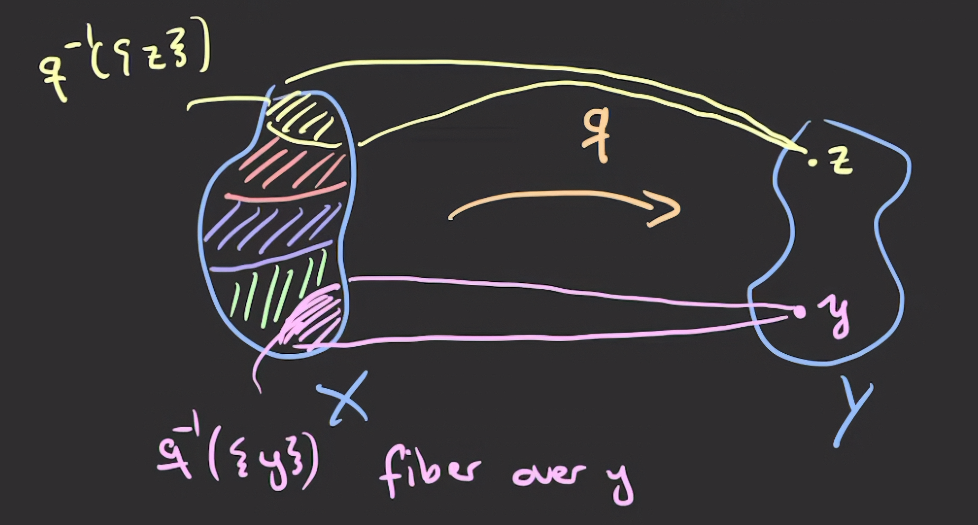
Similar to factor groups or factor rings we divide space into partitions (fibers or formally . can be viewed as disjoint union of non-empty sets (, with being a indexed partition, see Disjoint Union Space).
We can define such a function and get the partitions OR We can define the partitions indexed by and construct such a function OR We can define a equivalence relation and view the equivalence classes as partitions
View from universal property
Lemma
Let be a quotient map. For any space , a map is continuous if and only if is continuous.
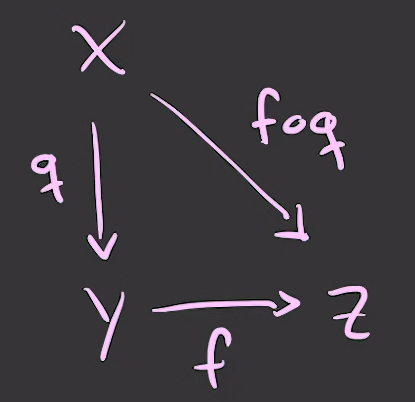
Proof is obvious Proof : assume is continuous Let open is open is open is open ( is continuous) is continuous
Important
The quotient topology is unique with this property
Universal Property:
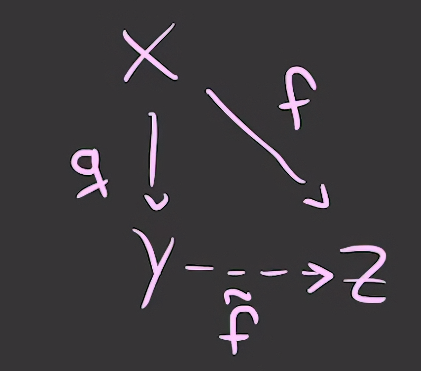 Let be a quotient map, continuous such that
Then there exists a unique continuous map satisfying (makes graph commute)
Let be a quotient map, continuous such that
Then there exists a unique continuous map satisfying (makes graph commute)
Uniqueness of Quotients
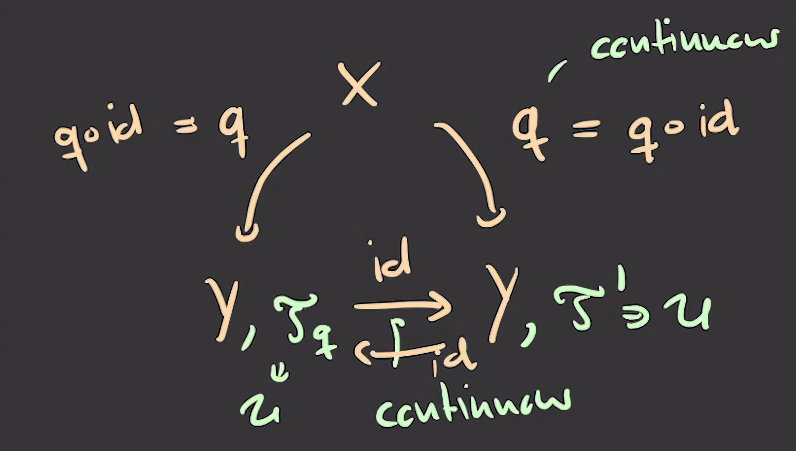
Suppose and are quotient maps satisfying
Then we must have
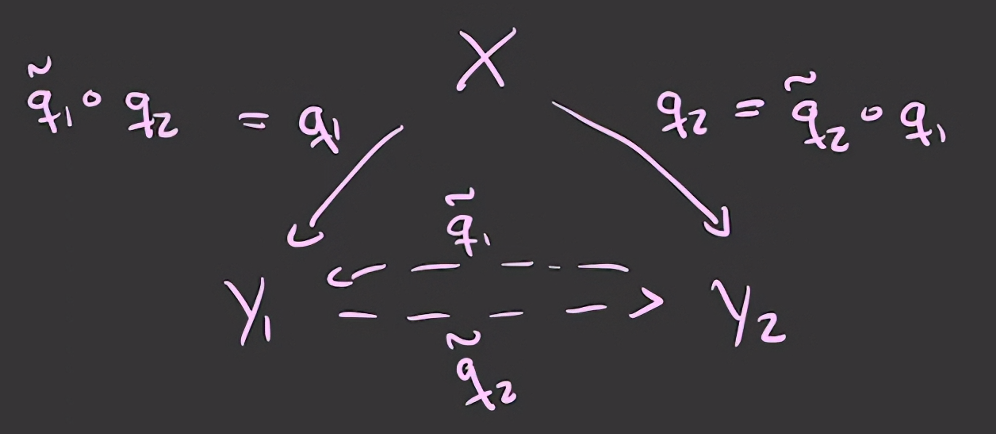 Then we must have unique and that makes the graph commute.
This relates to the universal property of quotient groups by replacing continuous map by group homomorphism and replacing homeomorphism by group isomorphism.
Examples
See Examples of Quotient Space
Property
Warning
Quotient space doe NOT preserve the properties like other spaces do (.. product space or subspace)
Let be an open quotient map (For every open set , the image is open, see open maps), then is hausdorff is closed in Proof: Take are distinct is hausdorff, by definition since and are both open in , is neighborhood of This shows the complement of is open, so is closed.
It is usually easier to check if is closed in the product space than to directly check whether is hausdorff
Other Properties
- Any composition of quotient maps is a quotient map
- An injective quotient map is a homeomorphism
- an injective quotient map is a bijection
- A subset is closed is closed
- If is saturated open or closed subset, then is a quotient map
- If are a family of quotient maps, then is a quotient map
- Any quotient of a connected space is connected, also works for Path Connectedness