Overview
A reorder buffer is used in out-of-order processors.
- in-order commit, so the visible machine state changes in program order
- precise exceptions, so traps appear as if instructions executed one by one
- branch misprediction recovery, by discarding speculative results that should not become visible
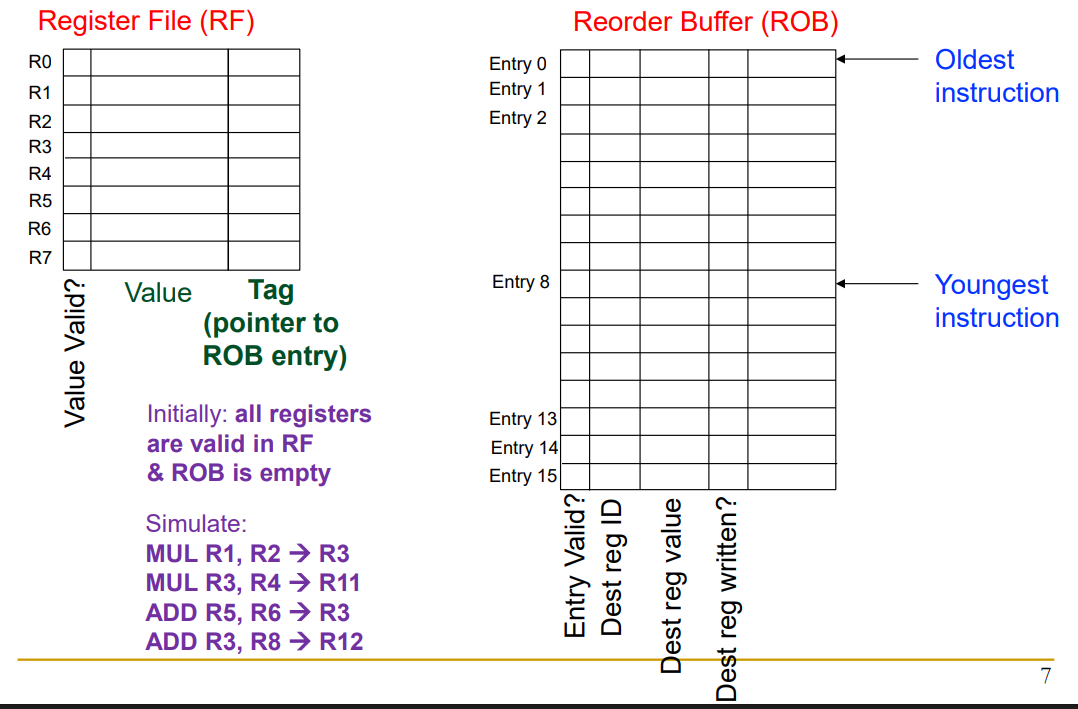
ROB entry
A ROB entry usually contains:
- the destination register, or information that the instruction writes to memory
- the result value, or a tag/reference to where the value will come from
- a ready bit that says whether execution has finished
- an exception bit or status field
- sometimes the program counter or branch information for recovery
NOTE
A scoreboard decides when an instruction may execute. A reorder buffer makes sure results commit in order and supports recovery.
Execution vs commit
It is useful to separate three steps:
- issue / dispatch: send the instruction into the machine and allocate tracking state
- execute / complete: compute the result when operands and functional units are ready
- commit / retire: make the result architecturally visible
The reorder buffer allows execution to be out of order while commit stays in order.
Example intuition
Suppose instruction I3 finishes before I2.
Without a reorder buffer, I3 might update the visible state too early.
If I2 then causes an exception, the processor would show an incorrect state.
With a reorder buffer, I3 can finish early and wait.
Its result becomes visible only when all older instructions have committed first.