Overview
Branch prediction is a microarchitectural technique that guesses the outcome of a control-flow instruction before the condition is fully known. It is mainly used in pipelined and out-of-order processors to avoid waiting until the branch is resolved.
Typical branches are:
- conditional branches such as
beq,bne - unconditional jumps
- calls and returns
The predictor usually tries to answer two questions:
- direction prediction: is the branch taken or not taken?
- target prediction: if it is taken, what is the next program counter?
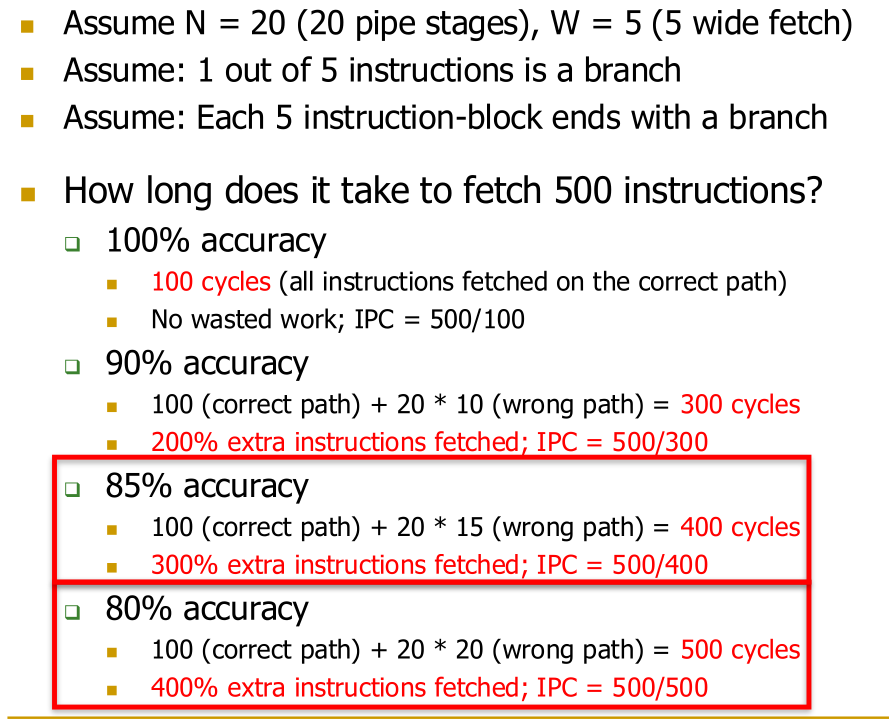
Static branch prediction
A static predictor does not learn from past executions. It uses a fixed rule such as:
- always predict not taken
- always predict taken
- backward branches predicted taken, forward branches predicted not taken
NOTE
Backward branches often come from loops, so predicting them as taken is often reasonable.
Dynamic branch prediction
A dynamic predictor uses past branch behavior to improve future guesses. This is important because many branches are strongly correlated with recent execution history.
1-bit predictor
The simplest dynamic predictor stores one bit per branch:
- predict taken if the bit is
1 - predict not taken if the bit is
0 - after execution, update the bit to the actual outcome
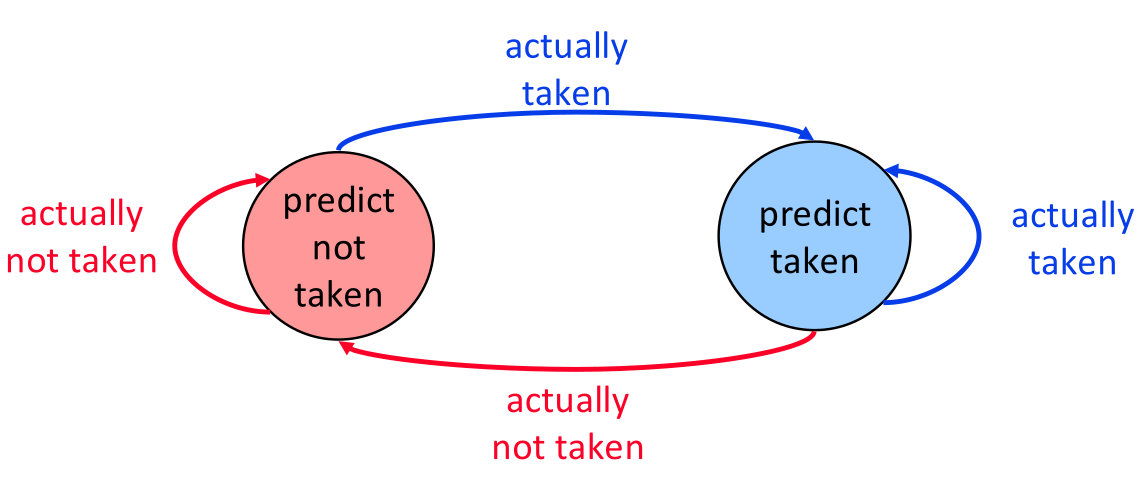 This works well for branches with stable behavior.
However, it performs poorly for loop branches because one unusual iteration can flip the prediction immediately.
This works well for branches with stable behavior.
However, it performs poorly for loop branches because one unusual iteration can flip the prediction immediately.
2-bit saturating counter
A common improvement is a 2-bit saturating counter. It has four states:
| State | Meaning |
|---|---|
00 | strongly not taken |
01 | weakly not taken |
10 | weakly taken |
11 | strongly taken |
| ![[Pasted image 20260423173250.png | 393]] |
| The predictor changes state gradually: |
- on a taken branch, move one step toward
strongly taken - on a not-taken branch, move one step toward
strongly not taken
So a single unusual outcome does not immediately reverse the prediction. This makes loop branches much more predictable.
Local and global history
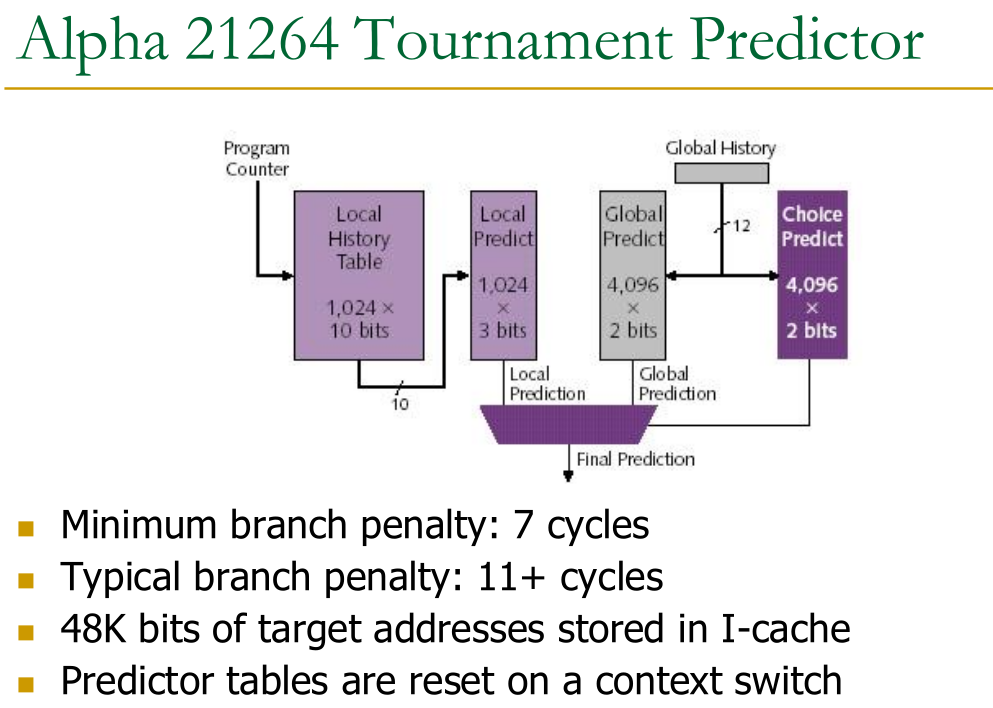
More advanced predictors use history patterns.
- local history tracks the recent behavior of one specific branch
- global history tracks the recent outcomes of many branches together
Perceptron predictor
A perceptron predictor uses a small linear classifier instead of only table counters. It combines bits of branch history with a set of learned weights and computes a score:
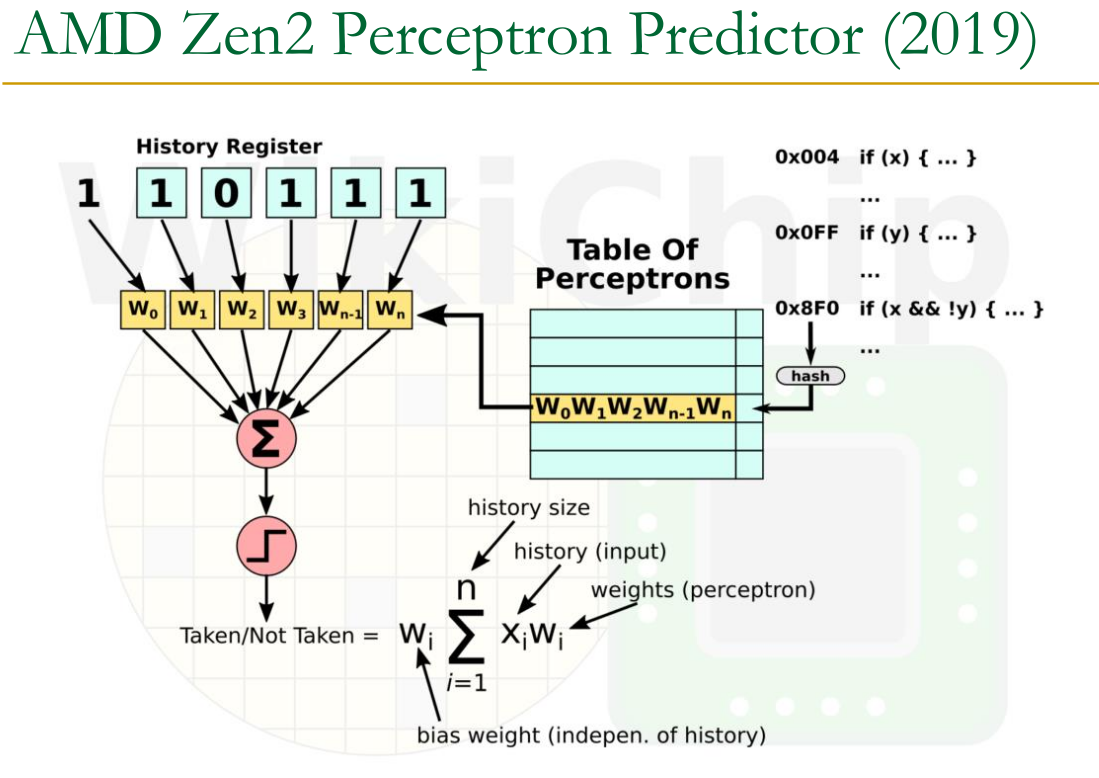 If the score is positive, predict taken; otherwise predict not taken.
This allows the predictor to learn longer-range correlations than simple 2-bit counter schemes.
If the score is positive, predict taken; otherwise predict not taken.
This allows the predictor to learn longer-range correlations than simple 2-bit counter schemes.
Its main disadvantages are higher hardware cost and a slower prediction/update path.
TAGE predictor
TAGE stands for tagged geometric history length predictor.
It uses several predictor tables in parallel, where each table is indexed with a different history length.
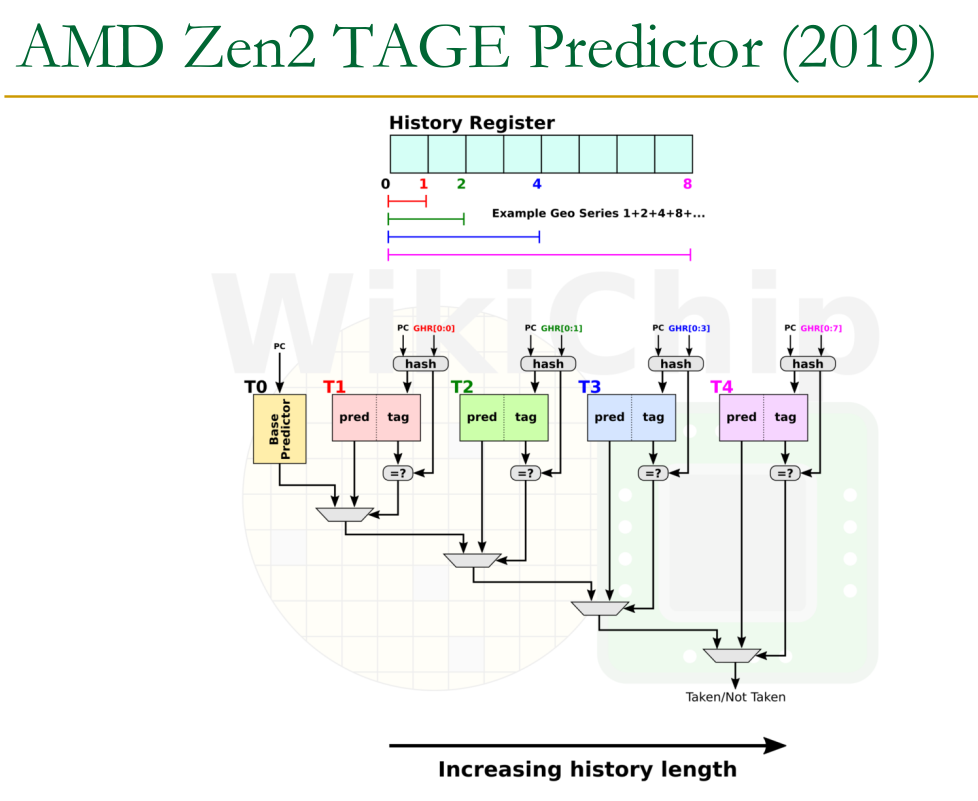
So:
- short histories capture simple recent patterns
- long histories capture more complex correlations
- tags help decide whether an entry really matches the current branch/history
TAGE is widely used because it gives very high accuracy while remaining practical to implement.
Branch Target Buffer
A branch target buffer (BTB) is a cache-like structure that stores the destination address of previously seen taken branches.
Without a BTB, the processor may know that a branch is likely taken but still not know the target quickly enough. With a BTB, the fetch stage can immediately redirect instruction fetch to the predicted target.
So in practice:
- the direction predictor guesses whether the branch is taken
- the BTB supplies the predicted target address
Speculative execution
Branch prediction is closely tied to speculation. The processor executes instructions on the predicted path before it knows whether that path is correct.
If the prediction was correct:
- the speculative work becomes useful and execution continues normally
If the prediction was wrong:
- younger speculative instructions are squashed
- the pipeline is flushed or partially flushed
- fetching restarts from the correct PC
In an out-of-order processor, recovery is usually coordinated with the Reorder Buffer, so wrongly speculated results do not become architecturally visible.