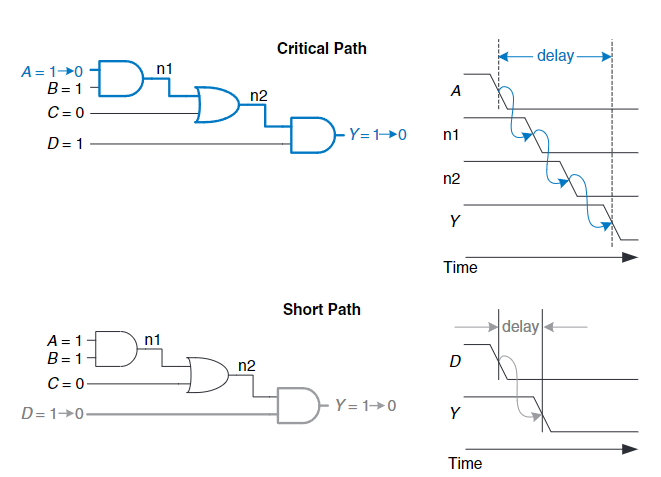
For Combinational logic, there are two kinds of delays: propagation delay and contamination delay.
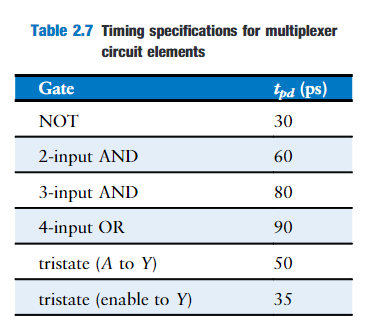
propagation delay: the maximum time from when an input changes until the outputs reach their final value. contamination delay: the minimum time from when an input changes until any output starts to change its value
measurement
We measure delay from the 50% point of the input/output signal. Half-way between LOW and HIGH
Temperature
circuits slowing down when hot and speeding up when cold
Critical paths are slower
Glitches
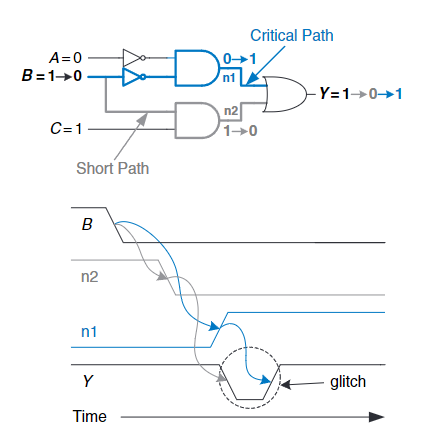
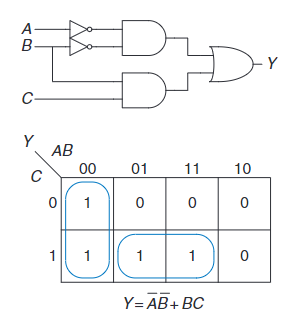
Logically, as goes from 1 to 0, output should not change. However, we can observe a short period of 0 because of the delay of the gates.
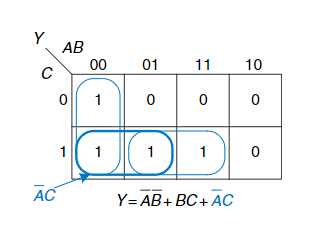
Glitches can occur as we transit from a blue circle to another. A way of avoiding this is to add extra hardware to make a glitch proof circuit. However, this still cannot prevent glitches when multiple inputs transit simultaneously. Therefore, our goal is not to eliminate them, but to be aware that they exist.
Sequential delays
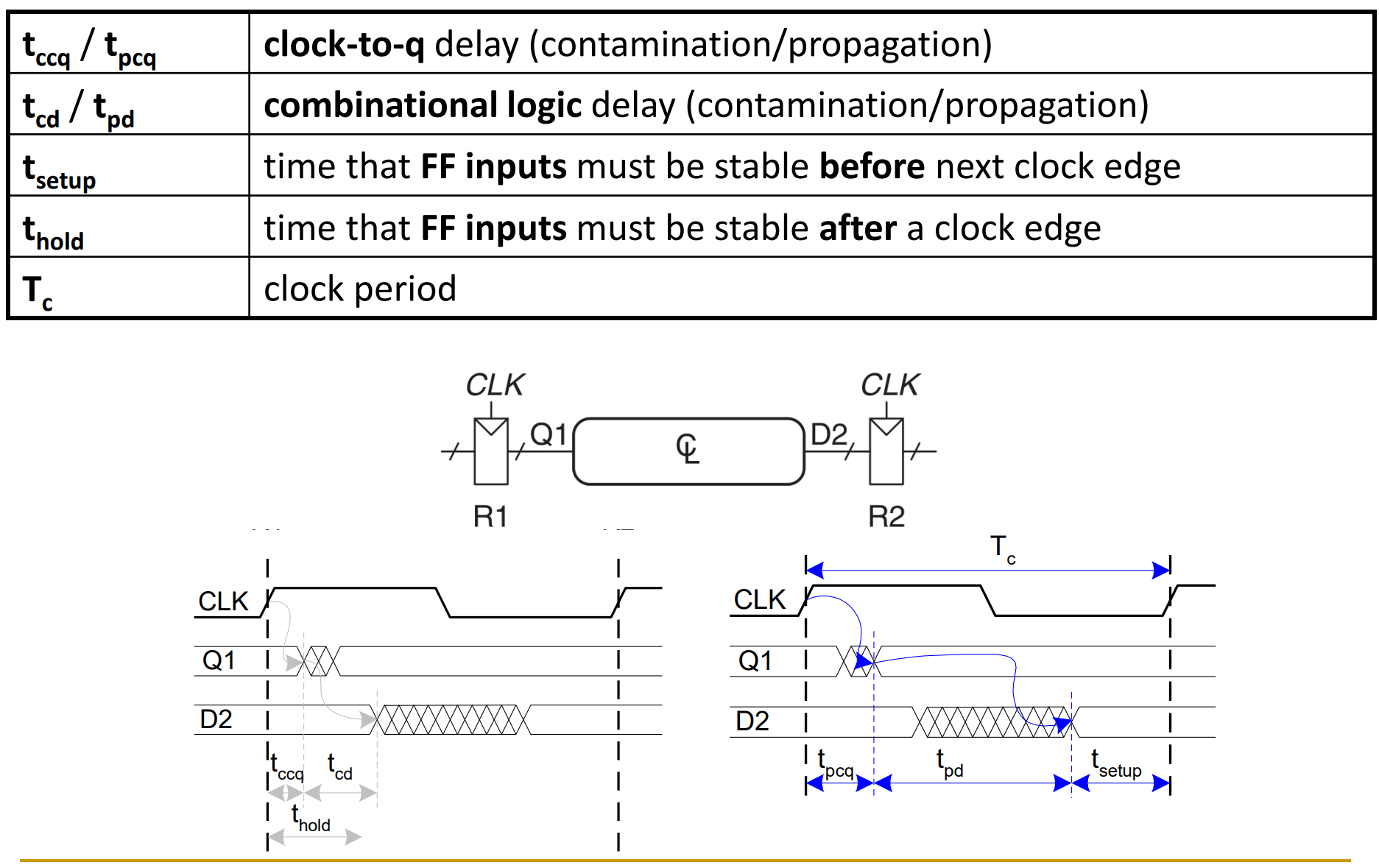
When an FSM signal is registered (state bits, registered outputs), it changes after the active clock edge.
- Contamination delay clock-to-q
t_ccq(min): earliest time after the clock edge whenQmay start changing. - Propagation delay clock-to-q
t_pcq(max): latest time after the clock edge whenQis guaranteed stable.
How these appear in basic synchronous timing (ignoring skew/jitter terms):
- Hold:
t_ccq(min) + t_cd(comb) >= t_hold - Setup:
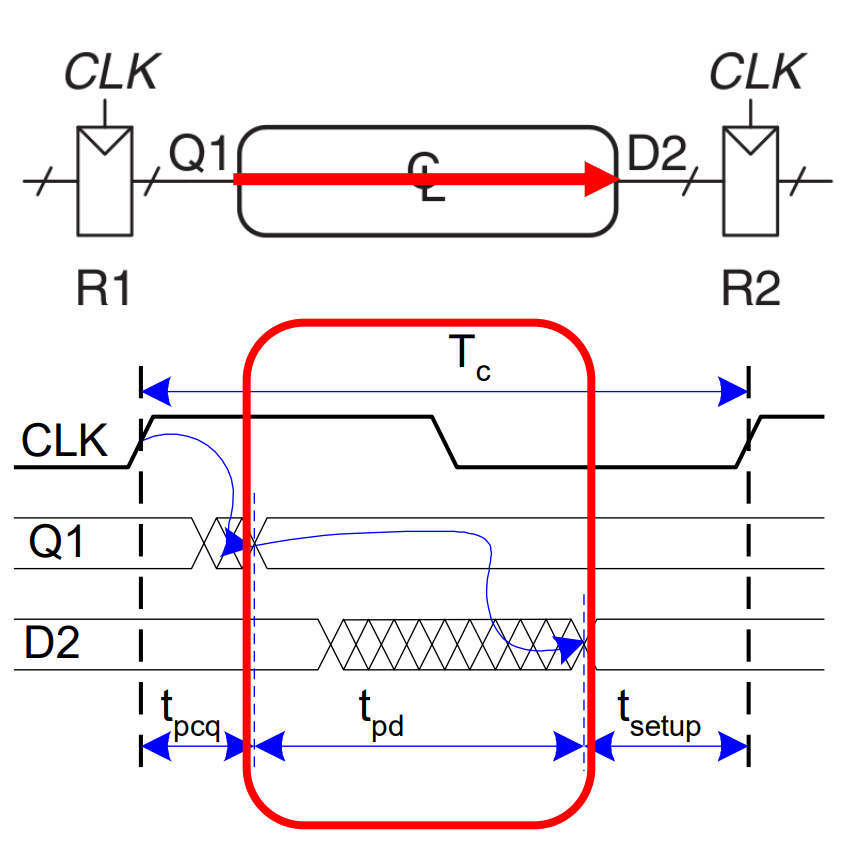
t_pcq(max) + t_pd(comb) + t_setup <= T_clk
(t_cd = min/contamination delay of the combinational path, t_pd = max/propagation delay.)
Ensuring correct sequential operation (R1 → CL → R2)
For two edge-triggered registers R1 (launch) and R2 (capture) with combinational logic CL between them, the input of R2 (often labeled D2) must be stable around the capturing clock edge:
- Stable for at least
t_setupbefore the active clock edge. - Remain stable for at least
t_holdafter the active clock edge.
This creates both a minimum and maximum allowable delay from R1.Q to R2.D:
- CL too fast → hold violation at R2: new data reaches
R2.Dtoo soon after the clock edge, soR2may capture the wrong value.- Condition (same clock, no skew/jitter):
t_ccq(min) + t_cd(comb) < t_hold
- Condition (same clock, no skew/jitter):
- CL too slow → setup violation at R2: new data arrives too late before the next clock edge, so
R2may not capture the intended value.- Condition (same clock, no skew/jitter):
t_pcq(max) + t_pd(comb) > T_clk - t_setup
- Condition (same clock, no skew/jitter):
Rule of thumb: setup is usually fixed by making the path faster or slowing the clock; hold is fixed by making the minimum path delay longer (e.g., added delay/buffers), not by changing T_clk.
Overview