10.2 Definition of Cosets
[[Math/ Books/A First Course in Abstract Algebra.pdf#page=102&selection=491,1,561,0&color=note|p.97]]
Let H be a subgroup of a group G. The subset of G is the left coset of H containing a, while the subset is the** right coset** of H containing a.
10.3 Example
Example
The left cosets of of are:
- The right cosets of of are:
NOTE
For a subgroup H of an abelian group G, the partition of G into left cosets of H and the partition into right cosets are the same. Trivial
10.4 Example
partition of into cosets of the subgroup
the cosets are
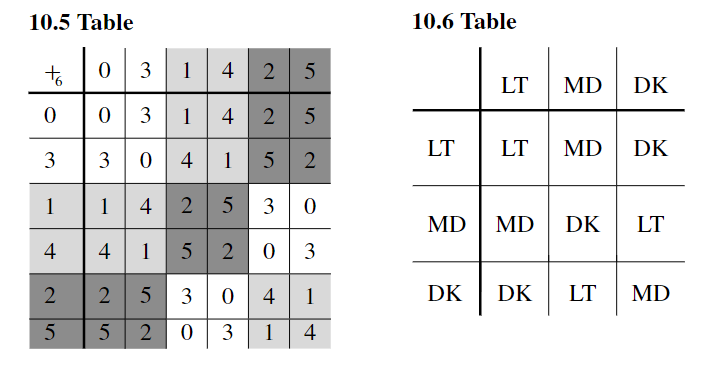 We see the partition of the group again forms a group. This group is called as Factor Group
The Theorem of Lagrange
[[Math/ Books/A First Course in Abstract Algebra.pdf#page=105&selection=241,0,254,1&color=note|p.100]]
Every coset (left or right) of a subgroup of a group has the same number of elements as . This means the order of divides the order of
Proof:
The proof relies on the concept of cosets. A left coset of in is a set of the form for some . Similarly, a right coset is . We will focus on left cosets, but the argument is analogous for right cosets.
- Cosets partition G: The left cosets of H partition G. This means that every element of G belongs to exactly one left coset of H. To see this:
- Every element belongs to the coset (since and ).
- If two cosets and intersect (i.e., have a common element), then they are equal. Suppose for some . Then . Since is a subgroup, . Let . Then , and therefore . Thus if two left cosets intersect they are equal.
-
All cosets have the same size: Every left coset has the same cardinality as H. This can be shown by defining a bijection by . This function is clearly surjective, and it’s injective because if , then by the cancellation law in .
-
Order of G is the sum of coset sizes: Since the cosets partition and all have size , the order of is the number of cosets multiplied by the size of each coset. Let n be the number of distinct left cosets of in . Then .
10.11 Theorem
NOTE
Every group of prime order is cyclic
a non-identity element g:
which has size . Lagrange says divides . SinceThe only divisors of the prime p are 1 and p. Therefore
10.13 Definition
[[Math/ Books/A First Course in Abstract Algebra.pdf#page=106&selection=91,2,120,1&color=yellow|p.101]]
The number of left cosets of H in G is the index (G : H ) of H in G.
10.14 Theorem
[[Math/ Books/A First Course in Abstract Algebra.pdf#page=106&selection=189,0,261,1&color=note|p.101]]
Suppose H and K are subgroups of a group G such that K ≤ H ≤ G, and suppose (H : K ) and (G : H ) are both finite. Then (G : K ) is finite, and (G : K ) = (G : H )(H : K )