13.1 Definition
[[Math/ Books/A First Course in Abstract Algebra.pdf#page=130&selection=123,0,141,8&color=note|p.125]]
A map φ of a group G into a group G′ is a homomorphism if the homomorphism property holds for all .
trivial homomorphism: for all
Tip
if G is abelian, then G’ must also be abelian:
Recall:
- on invertible n*n matrices (Determinant (legacy))
- matrix A is invertible if and only if det(A) is nonzero.
This means that det is a homomorphism mapping (the multiplicative group of all invertible n*n matrices) into the multiplicative group of non zero real numbers.
[[Math/ Books/A First Course in Abstract Algebra.pdf#page=132&selection=217,0,224,1&color=note|p.127]]
Homomorphisms of a group G into itself are often useful for studying the structure of G
13.7 Example
One can define multiplication by an integer as a homomorphism of integer addition to itself.
13.9 Example
One can also define integral on a certain interval as a homomorphism of function addition to real number addition.
13.10 Example: Reduction Modulo n
Here, it is a many-to-one map
[[Math/ Books/A First Course in Abstract Algebra.pdf#page=133&selection=286,0,354,18&color=note|p.128]]
Composition of group homomorphisms is again a group homomorphism. That is, if φ : G → G′ and γ : G′ → G′′ are both group homomorphisms then their composition (γ ◦ φ) : G → G′′, where (γ ◦ φ)(g) = γ (φ(g)) for g ∈ G, is also a homomorphism. (See Exercise 49.)
12.12 Properties of Homomorphisms
let be a homomorphism of a group into a group
- If is the identity element in , then is the identity element in.
- If , then .
- If H is a subgroup of , then is a subgroup of .
- If is a subgroup of , then is a subgroup of .
[[Math/ Books/A First Course in Abstract Algebra.pdf#page=134&selection=57,0,61,56&color=note|p.129]]
Loosely speaking, φ preserves the identity element, inverses, and subgroups.
13.11 Definition Im
[[Math/ Books/A First Course in Abstract Algebra.pdf#page=133&selection=395,0,511,1&color=note|p.128]]
Let be a mapping of a set into a set , and let and .
- The image of in under is . Similar to Definition of Image of group under a function
- The set is the range of .
- The inverse image of in is .
13.13 Definition: Kernel
Let is the kernel of , In other words: The Elements in G that correspond to the identity element in G’
Example: Linear Transformation Let and A be an matrix of real numbers: is a homomorphism, because This is known as a linear transformation. is known as the Null Space (Kernel of a Matrix) of A. It consists all such that (the zero vector)
13.15 Theorem
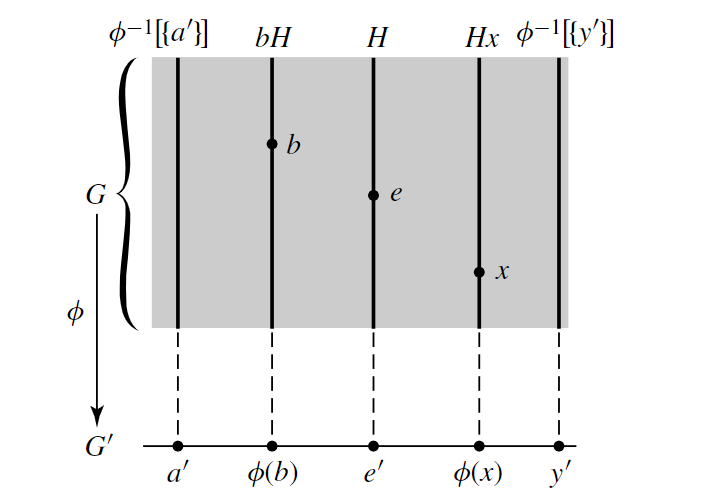
let , . Then: In other words.
- A coset of that contains a collapse into an element after the homomorphism.
- For any , the full set of things that share the same image is the coset a.
This figure shows how the Cosets collapse:
13.16 Example
Consider the group homomorphism
Geometrically, this map projects each nonzero complex number radially onto the unit circle.
13.17 Example
- Let D be the additive group of all differentiable functions mapping into
- Let F be the additive group of all functions mapping into
- = all constant functions, which form a subgroup C of F.
[[Math/ Books/A First Course in Abstract Algebra.pdf#page=136&selection=335,0,343,1&color=note|p.131]]
Thus Ker(φ) consists of all constant functions, which form a subgroup C of F
A better way is to say C is a subgroup of D, since is normally not defined in
Let’s consider an element of F, and all the elements in D that collapse into we know one element is . According to 13.15 Theorem all such functions form the coset . which is exactly the integral of
This proves that:
NOTE
If two differentiable functions have the same derivative on a connected domain, they differ by a constant (and nothing else).
13.18 Corollary of 13.15
NOTE
is a one-to-one map if and only if
How to show is an Isomorphism
- Show is a homomorphism.
- Show
- Show maps G onto G’
| Check | Criterion |
|---|---|
| Injective? | |
| Surjective? | |
| Isomorphism? | Both conditions above hold (homomorphism + bijective) |
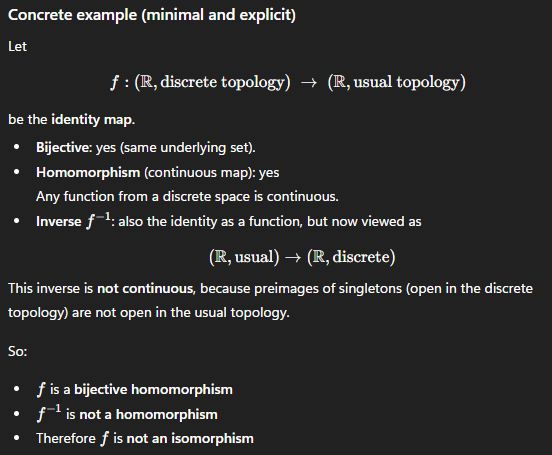
Warning
A bijective homomorphism is an isomorphism in categories where bijective homomorphisms automatically have homomorphic inverses (e.g., groups, modules, vector spaces), but not in general (e.g., topology)
An Counterexample
IMPORTANT
Every fiber of a homomorphism is exactly one coset of the kernel
13.19 Definition normal
[[Math/ Books/A First Course in Abstract Algebra.pdf#page=137&selection=182,0,210,1&color=note|p.132]]
A subgroup H of a group G is normal if its left and right cosets coincide, that is, if g H = Hg for all g ∈ G.
all abelian groups are normal. Trivial.
is always a normal subgroup of
Ways to Prove a Subgroup Is Normal in
A subgroup (H) is normal (denoted (H \triangleleft G)) if it satisfies any of the following equivalent conditions:
- Conjugation Closure Prove directly that
- Proof Outline:
-
Take an arbitrary () and ().
-
Compute and use properties of (e.g., how generators behave) to rewrite it as an element of H.
-
Since this holds for all g and h, we conclude , so H is closed under conjugation by every element of G.
-
Left and Right Cosets Coincide Equivalently,
- Proof Idea:
- To show , take any element . If H is conjugation-closed, then with , so .
- The reverse inclusion is similar. Hence for all g, and that’s exactly the condition for normality.
- Kernel of a Group Homomorphism If there exists a group homomorphism such that then automatically .
- Reason: Every kernel of a homomorphism is a normal subgroup. See Summary Ways to Prove H is a Normal Subgroup - Summary