Definition Extension Field
A field is an extension field of a field if .
Example: A tower of fields
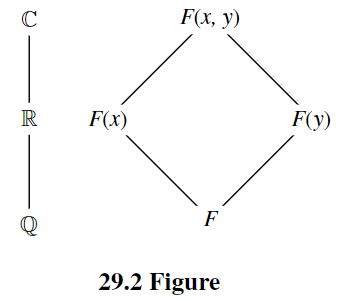 Here is the field of all polynomials with coefficients in (with an indeterminate ) (see Intro)
29.3 Kronecker’s Theorem
Let be a field and let be a nonconstant polynomial in . Then there exists an extension field of and an such that .
In other words, every polynomial has some root once you allow yourself to enlarge your field
- Proof🔽
Simple Examples of Field Extensions
Example 1: Extend
- We must firstly find an irreducible polynomial. In this case we use
- We find
- We force , and define an imaginary root so that (the choice of depends on the choice of the irreducible polynomial)
- We extend with this new element (normally written as )
- In the end we have
It’s interesting to know that according to Frobenius theorem every 2-dimensional extension of is . Understanding this is simple:
- suppose we define as
- we can always substitute for , and the result is still in the form
Example 2: Extend Similar to example 1 we find The result is , which is just
Summary
- Extending from is just an ordinary procedure. There is nothing special about , we can do the same for
- Note that unlike extending on , is structurally different from
29.4 Example: Construct Field Extensions
An alternative approach of example 1: we want to find the field
In the factor ring , every element is a coset of , so they are in the form of If we project of (the indeterminate, see Intro) onto the factor ring, we get
NOTE
Consider the homomorphism:
If we in insert x into , we get this: ( is just for simplicity)
29.6 Definition: Algebraic and Transcendental Elements
An element α of an extension field of a field is algebraic over if for some nonzero . If is not algebraic over , then is transcendental over .
Examples:
- is an algebraic element over , because is a zero of
- Similarly, is an algebraic element over
- and are transcendental over
- BUT and are algebraic over , for they are zeros of and respectively.
29.11 Definition: Algebraic and Transcendental Numbers
An element of that is algebraic over is an algebraic number. A transcendental number is an element of that is transcendental over .
29.12 Theorem
Let be an extension field of a field and let . Let be the evaluation homomorphism of into . e.g.
- for
Then is transcendental over if and only if gives an isomorphism of with a subdomain of , that is, if and only if is a one-to-one map
Proof: The element is transcendental over if and only if for all nonzero , which is true (by definition) if and only if for all nonzero , which is true if and only if the kernel of is (remember 13.13 Definition Kernel), that is, if and only if is a one-to-one map.
Notes: Remember The Fundamental Homomorphism Theorem:
- If is transcendental → →
- If is algebraic → → is not a one-to-one map
29.13 Theorem: Minimal Polynomial
If is algebraic over then there’s a “smallest” irreducible polynomial in (unique up to scaling) such that . Moreover, any other polynomial in that vanishes at must be divisible by this .
Proof
- We define firstly as the evaluation homomorphism of into (see homomorphism example).
- is an ideal and by 27.24 Theorem Ideal in polynomial Field, it must be a principal ideal generated by some
- we write this ideal as , every other with is a multiple of , and there exists a irreducible of minimal degree
Definition: monic polynomial
If we multiply a polynomial by a suitable constant so that the coefficient of the highest power of x appearing in of 29.13 Theorem Minimal Polynomial is , then this polynomial is called a monic polynomial
Definition: irr() & deg()
Let be an extension field of a field , and let be algebraic over . The unique monic polynomial having the property described in 29.13 Theorem Minimal Polynomial is the irreducible polynomial for over and will be denoted by . The degree of is the degree of over , denoted by .
Example: It’s easy to check that in , meaning that is also a zero of in . Using the Eisenstein divisibility check (where we pick ), the is irreducible in Thus, we have
Warning
We must always specific the field when we are talking about degree or algebraic. Example: is algebraic of degree 2 over but algebraic of degree 1 over , for .
Two ways of simple extensions
is defined as the evaluation homomorphism just as before
Case I
Suppose is algebraic over . Then the kernel of is , which by 27.25 Theorem is a maximal ideal of . Therefore, is a field and is isomorphic to the image in . This subfield is then the smallest subfield of containing and . We shall denote this by
Case II
Suppose is transcendental over . Then gives an isomorphism of with a subdomain of . Thus, is not a field but an integral domain (denoted as ) contains a field of quotients of (just like in Case I, it is denoted by ), which is thus the smallest subfield of containing and .
29.16 Example
Since π is transcendental over , the field is isomorphic to the field of rational functions over in the indeterminate .
Thus from a structural viewpoint, an element that is transcendental over a field behaves as though it were an indeterminate over .
It makes sense, because you can construct from , which can all be viewed as basis. Therefore, you get an infinite basis.
| Feature | Q(√2) | Q(x) (or Q(π)) |
|---|---|---|
| Type of adjoined element | Algebraic ( satisfies the polynomial ) | Transcendental ( satisfies no nonzero polynomial over ) |
| Vector-space dimension | Finite (2‑dimensional, basis ) | Infinite (basis ) |
| Typical element form | , with | , with |
| “Size” of the extension | Small—just one polynomial relation | Huge—no polynomial relations, so you get endlessly many powers |
29.17 Definition: simple extension
An extension field of a field is a simple extension of if for some .
29.18 Theorem
Let be a simple extension of a field , and let be algebraic over . Let the degree of be . Then every element of can be uniquely expressed in the form where the are in .
29.19 Example: Field GF(4)
- is a field
- consider , we want to find
- We know from 29.18 Theorem has elements 0 + 0α, 1 + 0α, 0 + 1α, and 1 + 1α OR 0, 1, α, and 1 + α
- THIS is a new finite field of four elements!!! called or
- The structure of this field is shown below
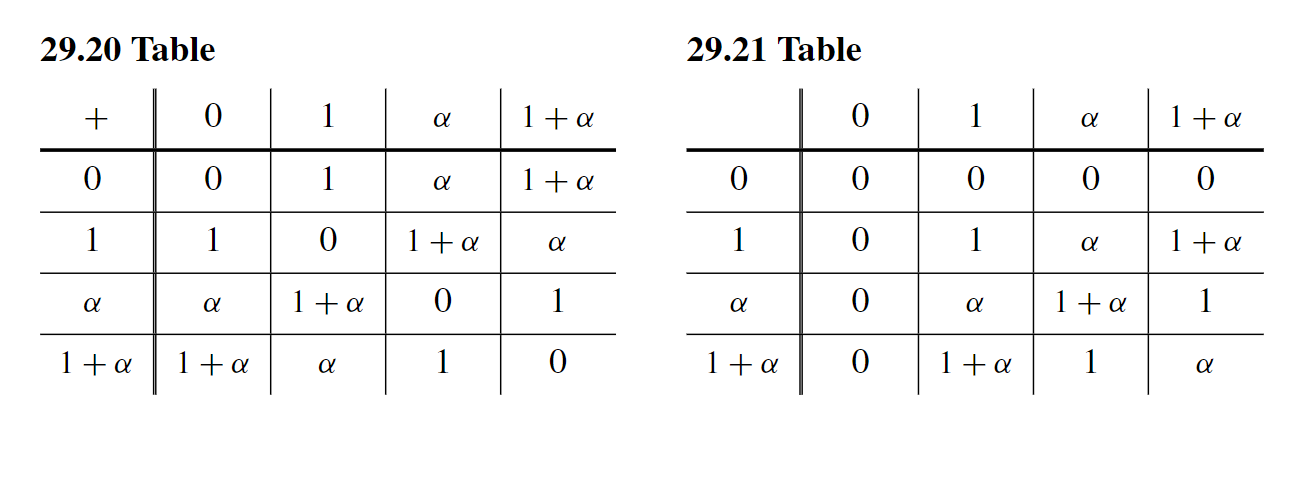
For example: , (note that in , and )
We can do the same to and we get as the smallest possible extension field.