Generally
Section 30 Vector Spaces
30.1 Definition: Vector Space
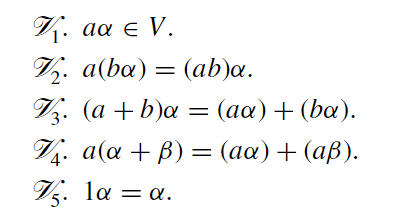
is a vector space over if: for all and
- a function (addition)
- a function (scalar multiplication) Example:
30.6 Definition: Span
If all vectors in the vector space can be expressed as a linear combination of a set of vectors in the vector space, this vector set span (or generate ) this vector space. If this is a minimal subset, it is a basis.
Basis
is a basis if is linearly independent and
30.9 Definition: finite dimensional
A vector space over a field is finite dimensional if there is a finite subset of whose vectors span .
30.11 Example
If and is algebraic over the field , then is a finite-dimensional vector space over .
By 29.18 Theorem is spanned by the vectors in , where . See in 29.16 Example
If , then every vector can be uniquely expressed by
30.21 Definition: Dimension
If is a finite-dimensional vector space over a field , the number of elements in a basis is the dimension of over .
30.22 Example
Link to originalLet be an extension field of a field , and let . If is algebraic over and , then the dimension of as a vector space over is .
In Linear Algebra
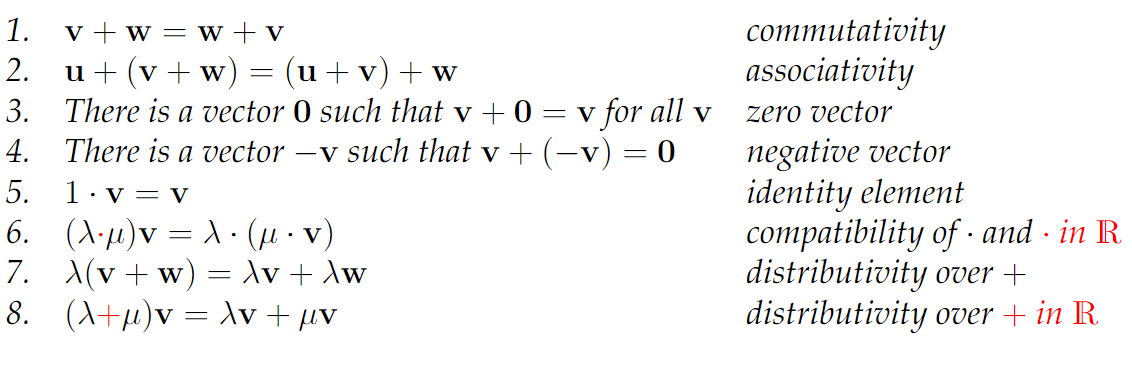
The eight axioms
Some ‘obvious’ facts
- There is only one zero vector. Proof: Take two zero vectors and (3. axiom) (1. axiom) (3. axiom)
- Each has only one negative vector
Subspaces
Let be a vector space. A nonempty subset is called a subspace of if
- and is also a vector space
Examples
is all quadratic polynomials This subspace is isomorphic to Prove isomorphism
NOTE
a polynomial should have finite terms
- all matrices of trace (What is trace of a matrix)
Lemma 4.16
Ever linear combination of is again in
Title
It has to be finite linear combinations
Examples of Basis
| Vector sapce | basis |
|---|---|
| independent columns of | |
| symmetric matrices (Subspace of ) | |
| (polynomials) | (infinite set) |
| (smallest vector space) | (emptyset) |
Definition: finitely generated vector space
A vector space is called finitely generated if there exists a finite subset with
is finitely generated is not finitely generated
Theorem 4.22
let be a finite subset with . Then has a basis
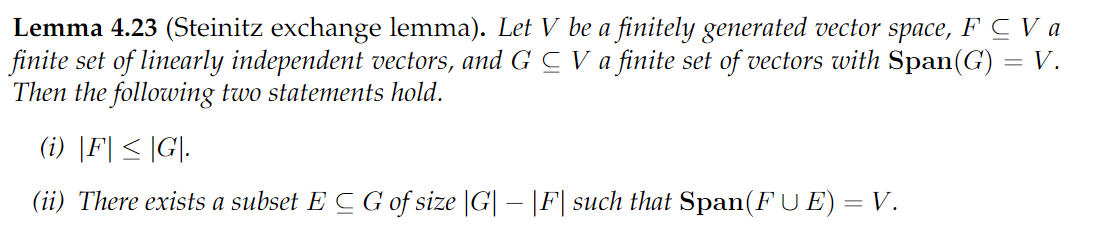
Steinitz exchange lemma
(ii) means: one can enlarge by some elements from such that the result has at most the size of and also spans
All bases have the same size
Link to original
Definition: Dimension
Definition
is the size of an arbitrary basis of
Linear transformations between vector spaces
NOTE
If a linear transformation is bijective. Then and are isomorphic (Prove isomorphism)
Here, isomorphic means the bases and dimension are preserved See Lemma 4.27
Example
, , or generally , This is bijective (invertible)
polynomials of degree 2, ,
NOTE
All m-dimensional (real) vector spaces are isomorphic