Disjoint union of spaces is the coproduct in topology. See coproduct in Type theory: Example Coproduct type A+B
Definition
Let be an indexed family of spaces, and let denote their disjoint union. Then a subset is open in the disjoint union topology if is open for each
Since we want to be continuous, for every open we must have is open. Note that
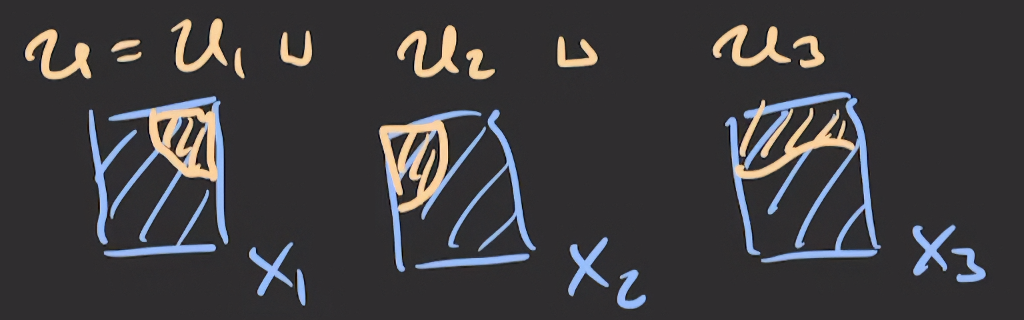
In simpler words: a open subset of the disjoint union spaces is a union of open subset of each space.
Notation
means inclusion map a map indicates and elements are mapped to themselves
Characteristic Property
Let be any space. A function is continuous is continuous for all .
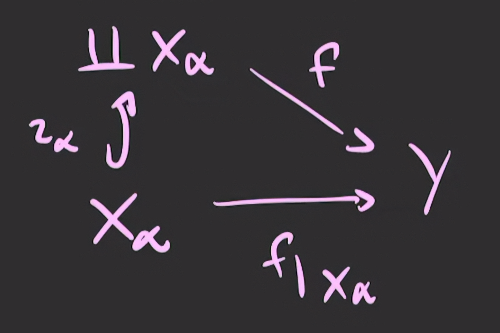
We try to prove the direction
Proof using universal property
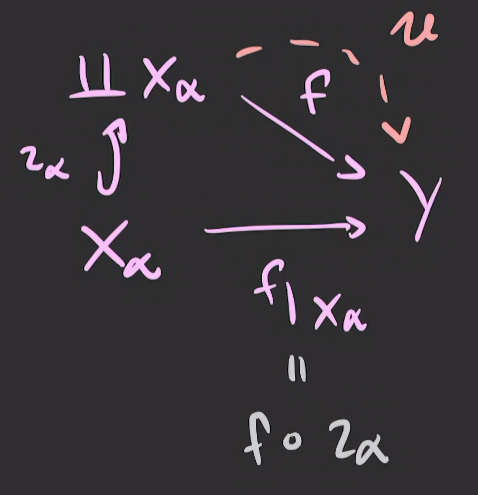 By universal property of the category of topological spaces we know that there exists a unique continuous map that makes this graph commute.
Title
Note that is unique among continuous maps, NOT among all functions. Thus, we need to prove is
That is
satisfies the universal property for disjoint union viewed as a set, because makes the graph commute. This gives as functions is also continuous
Note that this argument is almost the same as the arguments in Universal properties of Product space. Only the directions of the arrows are reversed
Proof using definitions
Let open we need to prove is open Consider Since is continuous, is open is open for all is open (by definition of coproduct)
Properties
- is closed is closed for all
- Each injection is an embedding
- a topological embedding means a map is a homeomorphism onto its image
- is homeomorphic to
- This is straightforward, because
- Taking disjoint unions preserves:
- Hausdorff property
- First countability
- Second countability, provided is countable